The attending physician will be wearing remarkable shoes. Impossibly glossy patent leather pumps that will overwhelm her lab coat and hint at the full and fabulous life she has outside the hospital. She will be a liver specialist, or an oncology fellow, or she will have recently published a well-received paper on Pulmonary Edema in a peer-reviewed journal. She will be impressive and you will try to impress her by asking smart questions. You won’t. She will be younger and more accomplished than you, and even though your interactions with her will tend toward unsatisfying, she will be excellent at her job – which is to teach twelve plump and rumpled residents from a lower-quartile med school about renal failure, or congestive heart failure, or inconclusive, simultaneous, multi-system failure in an 84-year-old white male non-smoker. The 84-year-old white male non-smoker will be your father.
You will have driven all night from the city you moved to, or the suburb you ended up in, listening to quasi-educational podcasts about serial killers, semiotics, and the more tawdry corners of American history, drinking ambitiously named truck-stop coffee, and second guessing your choice of rest area in the inky, hazy, no-man’s-land-time-of-night, when we all seem a little more anonymous and a little less accountable. The decision to leave your life and come back home will have been imperfect and impulsive. No righteous, eleventh hour, it’s go time moment. No swell of music indicating that your father needs you, and you must come to his bedside immediately. Instead, it will have been a series of setbacks, hospital stays, and soiled bedsheets. A fall, a troubling episode in a fruit market, a new symptom, a new infection, a new indignity, and a series of half-hearted, well-intentioned phone calls assuring you that you shouldn’t bother coming now because there is nothing you can do.
You will arrive at the house you once lived in and sit at table where you once did algebra and rolled your first joint. Your sister, or your aunt, or the neighbor lady who has been staying at the house to watch the dog and get the mail, will be up. You will ask her how he was today. She will raise her heavy, painted eyebrows and tell you he had a good day. Oxygen levels were up. He motioned for ice chips. He likes the ice chips. “And he’s complaining, so that’s a good sign.” She will say. “He’s being ornery.” She will brighten in that, at least there’s that, sort of way. A light in the hallway will go on, and you will hear your mother’s walker clack against the bathroom tile.
There will be food. Large quantities, gifted and delivered, in tubs, tins and foil. Saucy, creamy, complex carbohydrates hastily made in a sweet and naive attempt to make an uncomfortable, unknowable situation bearable through the anodyne of chocolate, eggs, and butter. There will be platters of sauced noodles, well-intentioned soups, creamed-based best efforts, and cheerful, uninformed cookies. Familiar food, made from ancient gravy-stained index cards, poured into crock pots and silver warming trays, bearing witness to holiday meals and family parties of years past, when the house was loud, and the uncles were still alive. A buffet of manufactured hope. This attempt at normalcy, and the failure to achieve it, will appear both ridiculous and noble. When we don’t know what to do, we eat. And maybe that’s okay. So, you make a plate and surrender to the agreed upon fiction that congestive heart failure can be mitigated by a bowl of Aunt Bonnie’s ravioli.
The morning will your brain will try to sort out where you are (childhood bedroom), why you are there (father ICU), and if there is any plausible chance this is a dream (it’s not). In the quiet that precedes the exigencies of the day, emptiness will hang heavy in the air, and you will realize this isn’t about him – or your experience of him. It won’t matter how big or small a life he led, or how much space he took up in a room. It will be the lack of him that keeps you from getting out of bed. Relationships are complicated and incomplete, filled with murky ambiguities, unrealized (and often unrealistic) expectations, littered with the passive aggressive flotsam and jetsam of imperfectly lived lives. Yours will be no exception. Your connection to your father will be equivocal. But his absence will be absolute. Home traded for hospital. Just like that.
The commotion of his last few days in the house, when everyone was overwhelmed and out of their depth, will have settled into silence. His clothes, his mail, his crossword puzzles, will be all around you. The artifacts and ephemera of a life, messy and scattered, preserved in the same disheveled array as the day the EMT’s rushed him to Emergency. The unspoken rule among your family will be that no one touches his things. They will remain as they are. As he left them. Until he comes home from the hospital. And so, you will move carefully through the clutter with a degree of reverence as if navigating the ambulatories of a shrine.
The Medical ICU will make you gown and mask before you enter his room as part of their pathogen protection protocol. This will be disconcerting for you, and for him. You will see it in his, still beautiful, blue-grey eyes, as they flutter open, trying to focus through the Fentanyl and figure out who you are. You will pull your mask down until recognition registers on his face. The good nurses won’t say a word. Over days and weeks, this ritual will become routine, and you will eventually develop a point of view on the “good gowns” and be able to tell newly shifted orderlies where the extra masks are stored.
You will begin a long, slow slog through a run of identical days, marked by tedium and uncertainty. Boredom and panic. From the very beginning of visiting hours, until the moment the night nurse shuffles in, clears his throat, and says something about only being able to bend the rules so far, you will be there. Every day. With no real role, other than to observe it all. There will be chest x-rays and bedside dialysis, biopsies, room transfers and a series of demoralizing failed breathing tests. You will come to know that rounds happen at 8:30am and 3:30pm, and you will time your trips to the bathroom accordingly, because you will consider it important to be in the room to overhear rounds, which is often the only news you will receive. And you will carry that information forward to the next day’s rounds when the entire care team has inexplicably changed, and a new attending physician, in underwhelming shoes, with a new cluster of clueless residents, will start from scratch, asking you the same basic lifestyle questions about your father that you have answered every time they begin another compulsory assessment checklist for his Medicare file, confirming only that he is still an 84-year-old white male non-smoker.
In the long hours between moments of consequence, you will help your mom walk to the cafeteria for uninspired coffee and navigate the equally uninspiring soup bar. You will come to know the hospital valet guy and eventually meet his special needs daughter. You will learn the difference between viral and fungal pneumonia and start to ask for the good third shift nurses by name. You will learn where they keep the apple sauce and graham crackers at the nurse’s station and how to sleep sitting up. And you will witness first-hand the high school politics of the hospital cafeteria as the surgeons, in their I just did surgery scrubs and Apple watches, talk animatedly around the big center table, while nursing assistants, inevitably more female and first generation, eat alone, out of Tupperware containers, on the fringes by the windows.
Over time, you will have unwittingly joined the quotidian flow of the hospital’s ecosystem, and you will come to realize a painfully obvious truth – this is their job. And nothing more. Your care team will be preoccupied, solipsistic, seekers of marginal utility, operating in their own self-interest. As they should be. As we all are. Of course, you will know this. Of course, you will understand this. And of course, you will forget this every time you see them flirting, or bitching, or ordering from Amazon, or playing the relatively benign passive aggressive politics everyone plays, at every place of work everywhere. You will try to remain untriggered, except your father is dying on their imperfect watch, and you will inevitably feel betrayed by their humanity. Even though you know it is not rational or possible, you will want them to stop everything and fully engage in your solipsism. But the hard truth will be that even though you have intersected these people at a time when your life is completely disrupted, theirs will be absolutely business as usual. And in their business, sometimes people die. And you will have to come to terms with the fact that your father’s red blood cell count may not be the most important thing in the world to an oncologist who is going through a messy divorce.
The mortality rate in a Medical Intensive Care Unit spikes to nearly 60% after day 21. Day 21 is the actuarial inflection point. You will not know this data at the time, but as the weeks go on, you will come to sense it. And so will your father. You will start to hear residents say things like, we need to get you stronger so we can get you outta here, as a cheerful rebuke to the overwhelming feeling that he will never leave the hospital. One late afternoon, he will be struggling to speak but not summoning enough strength to push air across his vocal cords. Your ear will be pressed to his lips. It will be excruciating as you hesitate to ask him to repeat it again and he struggles to be heard. Finally, “red box.”
“Red box?” You will repeat.
He will nod.
Your father will be a simple man of little means. But in his own humble way, he will have always tended to his family and taken care of you. You will go home that night, open his dresser drawer, and find a red box. Inside will be the paperwork from the VA indicating that they will pay for his funeral.
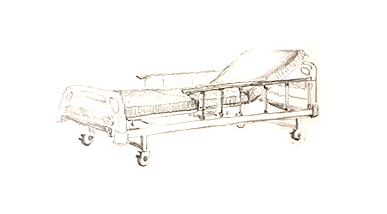
It will be a Tuesday, which would mean bedside dialysis, so you will have brought a book and a snack. You will be in a rush to get to his floor to try and catch the end of rounds. You will be alone - the first of your family to arrive at the hospital. As you come through the automatic doors of the ICU, you will hear the dwindling remnants of a commotion. In the hallway in front of his room, an orderly will be disposing of bed dressings. The assembled residents will not look you in the eye. You will enter with no mask or gown and you will be immediately struck by the infrastructure and apparatus around his bed. Big machines. Noise. A care team that seems to have doubled in size. He will be unconscious. And intubated. His arms strapped down with restraints affixed to the metal rails of his bed. The plastic tube running down his mouth and filling his lungs with air will appear impossibly fragile and cheap. Eight cents of Chinese PVC keeping your father alive. They will want to talk to you for a minute in the hallway. You will hear the story of the struggle with the night nurse. The pulling out of tubes. The trying to get out of bed. The writhing and thrashing that turned into a Code Grey. They will use words like agitated, restless and combative. They will inform you of the decision to sedate and the necessity to intubate. They will use clinical language and handbook protocols, but they will look spent and rattled. “He’s strong,” one of them will say.
In the following days, you will learn that intubation and sedation go hand in hand. If the patient becomes too aware, they will reflexively start to gag and attempt to pull the endotracheal tube out of their mouth. Given your father’s history, the anesthesiologist will be in often. By this point, your mom will be frail and often confused. She will be going through the motions, repeating the cycle, and like all of you, slowly surrendering to lack of information and loss of control. Over the past weeks, she will have insisted on sitting on an unforgiving wooden chair directly next to his bedside. They would play a game they had played since they were teenagers dating in high school. She would squeeze his hand once, are you okay? And he would squeeze hers twice, I’m okay. Day after day, they would do this for hours. He would be unable to speak or lift his head, but every time she squeezed are you okay? He squeezed, I’m okay. Until today. You will watch her squeezing his hand for minutes, then hours. Gently, silently, patiently waiting for a response that will never come. Until finally she will fall asleep. Her head resting on his metal arm restraints. Exhaustion eclipsing devotion. You will pull your phone out and take a picture which you will never look at again.
You will learn that the door next to the visitor’s bathroom that is never open is actually a small windowless conference room. When you enter, the attending and all five critical care leads will there, seated in a semi-circle. You father’s chart will be projected on a screen. The consultation will begin with a review of you father’s case and a short history of his decline. They will speak in soft but assured tones, with frequent practiced pauses to ask you of you understand or have any questions. They will cover options (few, bad), and potential scenarios (also few and bad). They will ask circuitous questions and speak in metaphor. They will talk about decision they had to make with their own family members and ask if you father had expressed any specific wishes in term of his care, or if you knew what he would want to do in this situation. And you will realize that this is all performative, and what they are really asking you is, how to kill your father. They will tell you it’s up to you. They can try and help him get stronger, pull the tube, hope he can breathe on his own, and if not, move him to the hospice floor. Or they can insert a trach, put him on a long-term vent and send him to an extended care facility with virtually no hope of improvement of recovery. Later that night, over a bowl of sauced noodles, sitting on a bed you used to make before first period, you will come to realize that your choice is no choice at all. Just two paths leading to the same unchangeable outcome. You will find no grace in this surrender. No peace in this truth. You will be too tired for gratitude. Poetry and perspective will be years away.
The hospice floor will be dim and quiet. What is supposed to be peaceful will feel suspicious. You will anticipate the formality and rigidity rules of the ICU, of which there will be none. The lack of screens and machines around your father’s bed will be disconcerting. The night nurse will be accommodating but creepy. Somewhere around 3am you will find yourself alone in the room with your father. You will touch his arm, but he will still feel far away, and you will begin to understand death as a process. For all his struggles breathing, he will now be taking deep slow breaths as his body transitions into Cheyne-Stokes respiration. You will watch his chest rise and fall. Finding reverence in the rhythm. You will fight the urge to rage against the absurdity of the situation. And you – like him – will finally, imperfectly, improbably, stop. You will cede control and enter the transformation. You will succumb and surrender, acting on instinct, doing things that change nothing and mean everything. You will be present and bear witness and see your father. You will burn the image of him in his bed into your brain and promise yourself you will never forget it. You will tell him a story and sing him a song. You will make a clumsy attempt at prayer, squeeze his hand once, and kiss his cool forehead.
And he will die.