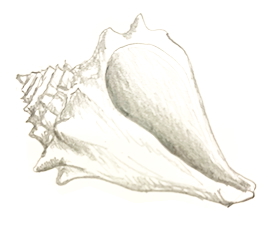
When the little boy’s head washes up on shore, Old Beelah is the one to find it. She is out at the beach early early early in the morning, picking up shells and sea glass and other treasures to sell to the tourists before they can come collect their own. Old Beelah takes whatever the sea can give her. She is dragging drowned tree branches off the beach to look for whelk shells when she spots it. The head is facedown in a tidal pool, seafoam frothing the shaggy brown hair.
“What are you doing out here?” she asks the head as she scoops the dripping thing into her arms. There’s wet brown kelp covering the face and she wipes it away. Underneath, the boy has coppery skin and dizzying freckles and long dark lashes closed tight against the salt air.
“Well, I can’t just leave you out here, can I?” she asks the head. She looks into her bucket of treasures and sighs as she dumps it out on the sand. “Can’t be helped.”
The head fits perfectly into the woman’s plastic bucket, and she tucks an old tea towel around it.
“You don’t terribly mind the bucket, do you?” Old Beelah asks the head. She is huffing and puffing her way up up up the gravel path from the beach to her little cottage. “I don’t want to drop you. And anyway, it’s really not that far. You’ll be fine in there.”
If the head has any objections to being transported in the bucket, it keeps them to itself.
As soon as Old Beelah gets home, she puts the head on the mantelpiece so he can see just about the whole cabin. It doesn’t take long for the neighbours to find out he’s up there, and they don’t like it one bit.
“Nobody takes a perfectly good boy apart unless there’s something wrong with him,” says Clora from up the road. Clora has more chickens than she needs, and she brings the extra eggs to Old Beelah sometimes. “You should just put this back where you found it.”
“He’ll have been no good,” says Orpham. He’s nearly as old as Old Beelah, but he still runs the pig farm on the hill and clears away downed trees in Old Beelah’s yard after storms pass by. “I’m doing a burn pile for tomorrow, I can throw him on there if you’d like. Take care of it for you.”
“I heard about a girl that washed up in pieces on that beach by the old Sambro place, past that little lighthouse there,” says Maddo. She drops by Old Beelah’s place when her husband drinks, which means Old Beelah sees a lot of her. “They kept her, and it was just awful. Oh, you can’t even imagine. You can ask Hildred about it, her cousin was one of the ones that found her. I think they took her apart again in the end.”
“They’re just afraid,” Old Beelah says every time the door closes and it’s just her and the head again. “They’re afraid and looking for something to be scared of.”
The head has been on Old Beelah’s mantelpiece for a month when she finds the first hand. She is back on her grey beach, sifting sifting sifting through the rough sand for smooth pieces of glass when she sees fingers bobbing in the incoming wave. The hand is boy-sized and copper-coloured, and she tucks it in her bucket of treasures and brings it home.
“This yours?” she asks the head that night, holding up the hand. The head doesn’t say anything, but she puts the hand up on the mantelpiece anyway, the fingers tucked under the chin.
After that, it takes five months for Old Beelah to collect enough pieces. She spreads them out one night on an old picnic blanket in her living room, and picks through a bucket of her sea treasures looking for shells smooth enough to be fingernails and sea glass blue enough to be his eyes.
“What do you think?” she asks the head. “Is this enough? Can you make do without a leg for now?”
If the head has any thoughts about the number of legs it would prefer to have, it doesn’t offer them up.
“I don’t think it’d be so bad,” says Old Beelah. “We’ll get you a stick or something.”
She is measuring and cutting the lengths of twine that she will use to put the boy back together again when she pauses and looks at the head.
“If you’re really no good, you should tell me now. I’ve done right by you, taking you out of the sea in my bucket and bringing you all the way here. If I shouldn’t put you back together, this is your last chance to tell me,” she says.
The head says nothing.
Old Beelah sits for a long time on her old picnic blanket, looking at the head and hands and elbows and the one left foot she carried out of the sea. And then she takes a deep breath and picks up her twine and sets to putting the boy back together again.
The next time Old Beelah goes down to the beach, early early early in the morning, she is holding the hand of a freckled boy with shell fingernails and a stick leg. Clora is already down there, filling a bucket with sand for chicken grit.
“What’s his name?” asks Clora.
“Haven’t found one yet,” says Old Beelah.
They watch him hobble down the beach, an empty pail for shells and sea glass banging against his wooden stick-leg.
“What if he’s no good?” asks Clora. “Will you take him apart again?”
Old Beelah watches him pluck a green fleck of glass from the sand and hold it up to the light.
“No,” she says. “I take whatever the sea gives me.”