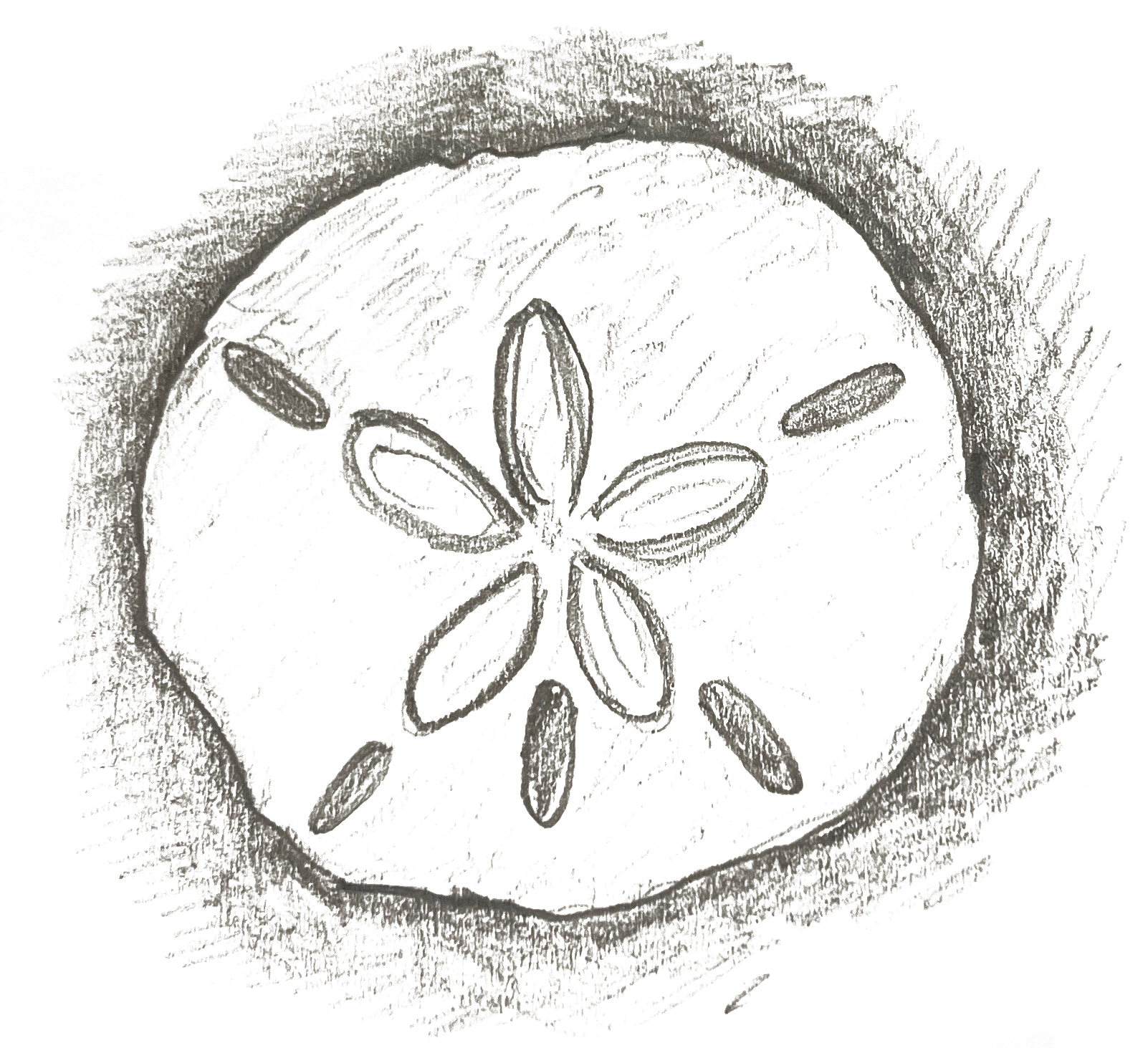
Christians devoutly imagine there are religious symbols and omens in damn-near everything: tireless bees, Jesus fish, heretical hyenas, bloody poinsettias, plantain-lined paths to salvation, thorny golden-crown flowers atop the twisted bodies of dogwood trees. Sand dollar mythology works best for my urchinous needs: shells divinely decorated with “Easter lilies” and “The Star of Bethlehem,” complete with evidence of Roman stab wounds to the body of Christ hung high up on the straight-wood cross.
That hoo-hah legend helps dollars sell better than most seashells, other than maybe pinky musical conchs dipped from tropical waters. Here in the Northeast, there’s a vacation market for bone-white rattling sand dollars, and for the chubbier sea biscuits; sometimes rich people purchase devout shells to decorate all the perfect table displays at their splashy seaside weddings. Either way, buyers want whole sand dollars, not broken ones. Those people don’t know what they’re missing, or maybe, when it comes to what’s broken, they turn their gaze away and just don’t dare.
I make good-enough money by walking New Hampshire’s thirteen-mile stretch of beach, seven days a week, collecting the occasional dead-bleached sand dollar and selling my finds to a trinket shop located on the tourist-trap strip of Hampton. My trade developed naturally, once I started marching as part of my personal therapy. The bubble-wrap filled backpack that I wear for stowing shell finds is a lot lighter than the 90-pound assault pack I used to hump, back in my salute-and-shoot days. Instead of an automatic weapon, my hands are now armed with an aluminum sand flea rake, complete with draining basket.
In summer months there’s a few old bastards always out, ankle-deep, metal detecting Rye Beach for lost rings and coins--fat-burnt Hemingway-looking greybeards who wave circle-wands and waddle around with a listening device in one ear. The other ear must but fairly attuned to the sounds of me wet-slapping or sand-kicking along, charging the beach with my rake in patrol carry position. They pause back or bumble out of my way. Depending upon what I gather or don’t gather, I go the full marathon sometimes: starting in Seabrook, and finishing up five hours later in Portsmouth, dipping a booted toe in the Piscataqua before turning around and rucking it back. Endurance is a spiritual attribute to my tactical fitness. I also believe in my all-terrain footwear, in hydration and packing extra socks.
Walking is part of my therapy process and journey, according to my case manager, Doctor Maggie Hammy or something like that--maybe Hamilton, maybe Hamncheese. She’s tedious and incessant, goes on and on about how a connection to nature can be both “supporting” and “comforting,” and the exercise can “reduce stress,” “lessen anxiety,” “improve mood,” all the while enhancing my “overall well-being.”
The sky and the salt and the sand and the gulls are supposed to help me serenely distance myself from any angry, misanthropic tendencies arising from PTSD, that, in the eyes of the VA who honorably discharged me, just won’t let me be. She talks positive, tells the plovers and sandpipers and lesser yellowlegs that I’m “walking toward peace.” I refuse to do office visits, so Doctor Hammy meets me in Hampton or Rye or New Castle, walks a mile or two with me, conducting her sessions and verbally pumping her designs while we’re on the move. I don’t slow down for her. Sometimes, I walk away.
Dr. Hammy’s tried to get me into CBT, wants me to talk about and re-route negative, possibly abbreviated dark thoughts. She’s told me: I have chronic PTSD, and I’m operating with Avoidance since I negate all two-sided conversation with her. She claims that I’m hypervigilant. On a stretch around the Dover area, she hustles to stay even with me, says, “I hope you’ll choose to talk, join the conversation at some point, Ian. So far, I really haven’t been able to help you with identifying any harmful, event-related thoughts. If you won’t talk, there’s no way I can properly assess your stress levels; I’m happy you took to the walking, that you nodded and agreed to the exercise-and-setting therapy sessions--but otherwise I’m coming up short on suggestions for coping mechanisms that might help you make the next, metaphorical step.”
If I felt like responding to her, I’d tell her: it’s a whole lot more peaceful when nobody’s running off at the mouth. If she didn’t join me on my dollar walks, hooking on to me and drowning out the natural susurrus all around us, then this wouldn’t be the worst pay-gig in the world. I make a half-dollar for each sand dollar that I find. If Dr. Hammy finds one, she always gives it to me—after all, she’s making big moolah for our therapeutic sand dance. She talks about “being present” and using “mindfulness,” suggests paths toward Harmony—suggests that I sample meditation, or yoga, or joining Home for Humanity builders or even attending church—doesn’t matter if I believe, she says, it’s about holding communion with good people all around me.
Dr. Hammy knows not to mess with me about alcohol abuse or pharmacotherapy measures. I don’t have AUD, don’t even touch beer or the hard stuff. I don’t want my system brimming with all sorts of distillates and drugs; she thought I might be experiencing MDD, and when she suggested Sertraline for what she suspects is my Major Depression Disorder, that was no better than firing into dark horizons without the benefit of night vision optics; no more drug recommendations after I accepted the first paper prescription she handed to me, which I placed into my mouth, chewing and swallowing it right in front of her.
There was a time when I smoked red-packed filter-less cigarettes to hold myself down, but I’ve moved on from that crutch. I no longer inhale NNK, NNN, NAT, ammonia or hydrogen monoxide. I like my teeth way too much to ever line my gums with packets or dip. Vapes popcorn the lungs of the ill-informed and the silly. I’ve come to realize that I’m averse to made-by-other-men manmade poisons.
Cutting along New Hampshire’s relatively tiny shoreline, I don’t look at any of the high-end homes and bastions and mansions. I ignore Newcastle’s 150-year-old Wentworth-by-the-Sea, an old and opulent Grand Hotel. A grunt like me shouldn’t darken the gold filigree doors of such a fine place; no longer in Service, I’m no more than a pedestrian rube, unworthy of even using their garden hoses to boot and feet clean. Money like those places and people—it ain’t exactly sand dollars. But those are lifestyles I faithfully defended. I’ve never expected them to look out their tall windows, study me scavenging, wave their arms hello.
Hammy brings me other kinds of defenses: SPF 50 spray, and a not-so-cheap pair of wraparound sunglasses. Useless. Of course, I don’t care if my skin crepes so bad it tears like tissue paper, and if the Sun strikes me blind, then that’s meant to be. I’m hot and spiritual with that big ball of nuclear fusion, and I don’t need any blockers interfering with our warm and blistering interactions. In winter, when the sun thins low, the return trips turn dark around four o’clock. Overhead, I have all kinds of sun-stars, the occasional satellite tracking, red-lighted cargo planes, and moons that run from Hunter to Blue. I walk the beach. Don’t give a shit if there’s rain or hurricane, with foamy waves raging in and dragging backhoes of sand and creatures out into the biggest, sweetest maw of all. I walk the beach. I pick up and sell the skeletons of our Creator-God-whatever-his-name-is-Guy’s gentle creatures. I’m alive and walking the miles.
Every once in a while, Dr. Hammy sees a mackerel or a striped bass jump high, out in the waves. I don’t tell her how they’re probably dodging sharks; she goes off into Christian-symbol world, talking about how Ichthys and faith and being fishers of men have helped millions of “Travelers” get through this complicated life. It’s all Greek to me. Most of the fish I see are lying along the shoreline--smelly, picked-over carcasses that won’t be there much longer, depending upon which voracious creature snatches what’s left once we’ve passed by. Hungry little sand crabs burrow and peek out in the swash zone, while herring gulls and common terns stand or skitter all along the shore. Yesterday she heard the ringing call of a Great black-backed gull, pointed it out to me, and then the highly informed ornithologist Dr. Maggie Hammy misidentified the species and proceeded to elucidate on how the noisy bird was a fine example of a laughing gull, a funny kind of scavenger. I kept making tracks.
Dr. Hammy knows from my file that I like history and the outdoors. She’s maybe thirty, and her hair is already the color of a silver hake. She’s fit, I’ll give her that, though sometimes she prattles so much that she forgets to breathe and so she halts, hands on knees, catching her breath. If I’m not stopping for a shell, then she has to jog a stretch to catch up. She annoys me, regularly, trying to educate me during our beach walks. Last week she was yakking about all the cool and quaint sights around Portsmouth, asking me about historic Strawberry Banks, and if I’ve ever seen the closed-down Naval Prison near there. I have not seen it there—because it’s in Kittery, Maine. It’s an impressive, fortress-like structure, once known as the Alcatraz of the East. Before the military figured out one part of what we were doing wrong against humanity, that’s where they put prisoners who had committed what they called “crimes of a nature not relating to women.” Dr. Hammy said it’s a shame that a place as palatial as the Portsmouth Naval Prison is no longer in active use. Imbecile. I shook off her ignorance--but I maybe started on the path to belief in God when she finally stopped talking to me and veered off to meet another “walker friend” (i.e. patient) to chatter at and educate, while plodding south, back to her parked car.
She’s a babbling estuary of mixed-up waters, a brackish-minded fool. Dr. Hammy acts like she has the answers, but about an hour ago, when we walked past a couple of old coot-boys surf fishing, she glanced in a white bucket they had off to the side, while the quiet men arced lines and baits back over their shoulders before 10-2 launching them forward. We kept going, and once we were out of the fishermen’s hearing distance, Dr. Hammy whispered, “Gross. Using squid for bait.” The bucket’s contents and the bait: looked and smelled like mullet to me.
But now she’s wrong. So wrong. Dead wrong. Dangerously wrong more than ever. Odiorne Point is the best area for finding shells out of all the New Hampshire beaches—the oceanside is rocky in places, with tidal pools full of sea life. Sand dollars can be found congregating in granite pots filled with sluicing seawater, up in the outcroppings. I choose to let them be. Hammy’s veered off to a massive semi-deep basin among the rocks; her hand is poised, just above the surface tension of a pool harboring maybe a hundred live, dark purple sand dollars. The dollars slowly move around on the wave-fed surfaces, meandering on tiny cilia undulating out of their bodies. It’s only when they die--leaving behind their hardened, bleached-white remains--that I take a sand dollar and give it another life.
My voice comes out growling from disuse. “Don’t touch them. Touch them, and they might hurt you with their spines, and your stupid ways of handling them might kill a few, and then I’ll kill you.”
She looks me straight in the eyes. “Those spines are sharp, but they aren’t poisonous, Ian, and they can’t bite you with their tiny mouths. What’s the problem?” Her hand holds its position.
I grip my rake, bear it tight across my chest. “Stand up, Doc. Move back from the tidal pool, slowly.”
She stands up, but she doesn’t step back. “I’m a seacoast girl, Ian, born and bred. I know how to handle live sand dollars. And I don’t mind getting a little of that yellow stainy-stuff on my hands. I know how to be gentle.”
So numbskull. “Echinochrome. Messing with a sand dollar’s calm day and biology, getting it all stirred up—that “stain” as you call it could spread around and negatively affect other life in the pool. And even if you remotely knew what you were doing, why would you do it? Why can’t you let things be?”
Doctor Hammy takes a step toward me. And then another. I think her name is Hamilton. I’m cresting a little, ready to pound rock, but I don’t want to do that. So, I let my silence break and break again: “And Portsmouth Naval Prison was a terrible place for people serving their country as honorably as they could, and it’s in Maine, dumbass, and me, I’ve committed crimes of a nature. A violent nature. I have no words for who and what that was against. And you don’t know a sea cucumber from a star fish.”
She smiles, maybe a touch of sadness in the corners, walks toward me and stops a bit too close for my comfort. She notices, takes one step back, puts a hand to her head and brushes back loose strands of her silver hair. A sneaky herring gull circles and squalls above us, an opportunist beady-watching in case we were to drop something.
“I’m willing to learn. Why don’t you teach me what you understand about sand dollars? I promise I’ll shut up.” Her hand gestures forward, gesturing us out of the rocks toward where the sand starts again. We head that way, leaving the moving, purpling pool behind us.
We need to get this religious stuff straightened out and settled, too. “You only pick up dead sand dollars. And that little rattle inside? The symbolists say those are five tiny doves. I pick the “doves” out of the broken ones I find because I can make a little, selling them by the bag. A sand dollar’s exoskeleton is made of calcium, that’s why they’re white when they die and dry out. The stab holes and flower patterns and keyholes are actually pores, and those so-called “doves” are what pass for sand dollar teeth, but they’re really just hardened muscles and skeleton.”
Dr. Hamilton says, “Calcium carbonate.” I feel my head jerk back into my pack. Damned if she isn’t right. Her hand goes to her mouth. “Oops. Sorry.”
I take a breath, relax, get us walking again. “Christians think that when you break open a sand dollar, letting the doves out, then you’re releasing peace and goodwill into the world. That’s a load of seagull shit, if you ask me.”
Dr. Maggie Hamilton double nods at me, her eyes filled with questions.