That summer his father went to jail Jeff Millberg was sixteen and fully licensed, but without a car of any sort. In June Ellie Fendel became his girlfriend. Prior to that summer he’d known her principally as one of those girls who doodled horses in art class and played clarinet in the high school orchestra. Near the end of that school year, their class took a field trip to New York City and, who knows—maybe seeing her outside the confines of the school building, all her yellow hair in the sun—Jeff spent the trip jostling to get next to Ellie for posed photographs on the ferry to Ellis Island, in front of F.A.O. Schwartz, the stone façade of some city park or another. After the trip a small group met at Hal Halyard’s house to share a few swiped cans of his dad’s Genesee and throw horseshoes and Jeff, under the marble trance of a school day spent free from school, challenged Ellie to round after round of thumb wrestling.
“You have girl thumbs,” Ellie said. “I could whip you in this if I were trying.”
Ellie’s hands were warm and soft, and she smiled and looked good in a t-shirt. They laughed about things that happened on the trip. Jeff’s friends couldn’t tear him away, couldn’t distract him from Ellie, who was suddenly, right there, the most incredible thing he’d ever seen.
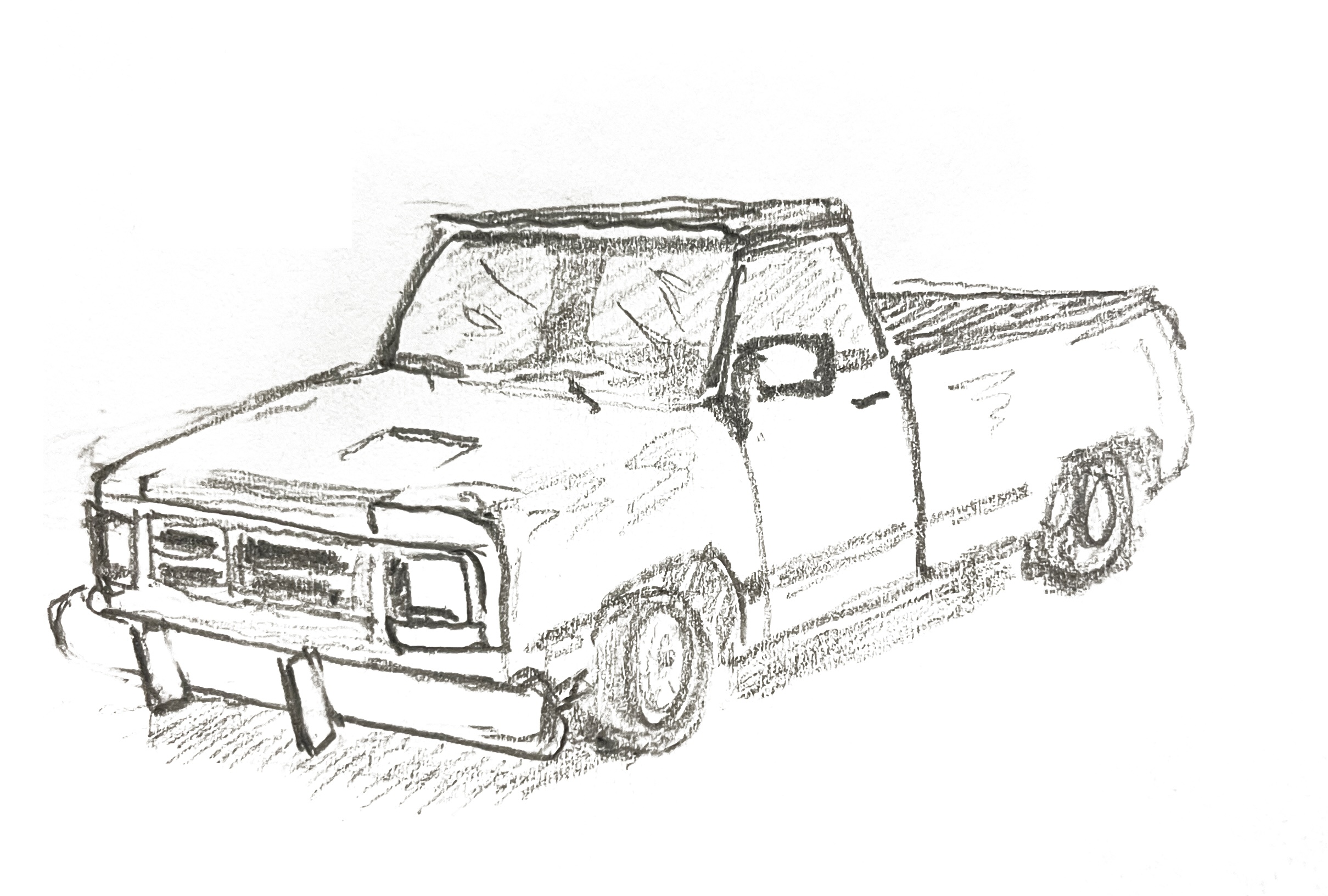
For some reason Jeff never knew, Ellie had access that summer to her uncle’s red pickup truck—a 1987 Dodge with manual windows, manual locks, and tan leather interior with several seam rips and cigarette burns in the seats. They drove windows down along curving, wooded roads, Ellie’s hair blowing around, the truck shifting beneath them like an animal, a beast working hard to get them where they were going. Jeff felt unbeatable in the plush, high-up driver’s seat, Ellie next to him. They drove the county’s expanses, sometimes riding the old road to Albany and back in a single day, visiting small mill towns and a coffee shop run by two gray-haired lesbians, where Jeff and Ellie sat in cushioned rocking chairs and sipped mochas from enormous mugs and felt free, a thousand miles and maybe even a few years from home, though they weren’t more than an hour’s drive. At night, they rode out to Fisher Meadows and parked in a gravel lot behind the little league ball fields by a line of wet dogwoods. Invisible mosquitoes bit exposed skin and the warm cans of beer they shared leached their throats dry. Most weeknights they were alone, except for the occasional bored cop roaming the woodsy night in his patrol car, although on weekends the Meadows bloomed with other foggy-windowed cars, thick air that on other nights was consumed only by insect humming now punctuated by laughter and the pinging of pebbles against empty aluminum cans, skid of tires on loose gravel as the Farmington’s Valley’s night lucky high schoolers tested the elasticity of curfew.
Ellie called herself an old soul. In the pickup, they listened to Jackson Brown and Stevie Nicks and others of their parents’ generation. “The Pretender,” “Rock Me on the Water,” and Side B of Bella Donna were her favorites. Jeff had never heard that music and soon associated it so closely with Ellie that the songs seemed to be about the two of them, even those about couples in their twenties or thirties or older, living in apartments, stockpiling love affairs. Folks who worked jobs and came and went as they pleased, rather than Jeff and Ellie, who had achieved only the very fringes of independence but were still largely under parental control and slept in the same rooms they had as children.
Once or twice, he slipped his own tapes in the deck—Mudhoney or Pearl Jam or Candlebox—and Ellie made a disgusted face and covered her ears theatrically and called it noise. Jeff capitulated, replaced his tape with hers, and soon they were singing along, windows down—“When the morning light comes streaming in, I’m gonna get up and do it again. Amen.”
At home Jeff’s father terrorized inanimate objects. Though he largely avoided alcohol, Harvey Millberg had the hair trigger mood spells of a serious drunk. He kicked the television, maneuvered the oven into the middle of the kitchen, lacerated the stereo with a screwdriver because it refused to eject a CD, even once, provoked by something his mother had said, punching a hole in the hallway drywall, after which he wore a cast for weeks. His father’s spells of rage were like a tectonic shift or lava flow or some other natural disruption, the cause for which lay in the very ground itself. And like those who live on a fault line or by an active volcano, Jeff and his mother simply learned to live with the threat of destruction. They didn’t talk about it. They didn’t really even fear it. Instead, they minimized their risk by spending as much time as possible outside of the house. His mother, who worked for the city health department, spent many evenings at the office or playing canasta with friends, while Jeff now had Ellie, her uncle’s red Dodge, and the incredible expanse of Fisher Meadows.
From their initial, tentative pawing in the bed of the truck, they quickly escalated to the rapid shucking of clothes. They groped not only at Fisher but everywhere else that offered even the smallest degree of privacy at night: the golf course, the church parking lot down the street from Ellie’s house, once even on a Sunday afternoon in Ellie’s own backyard, with her parents and sisters inside the house. They rolled between two blankets fifty feet from the back porch, obstructed only by a two-foot blueberry bush trying its best not to watch what went on at its feet. For a month it went like that. They were maniacs for each other, assiduously groping and kissing, and the tighter Jeff squeezed, the harder he ground his pelvis against her hips, the heavier she breathed and exhaled his name. But by the time July rolled around, Jeff saw a barrier as impenetrable as a naval blockade. Some nights, without warning, Ellie would put a lid on things and that would be that. She’d pull herself back and sit up in the truck bed and ask Jeff to get her pack of cloves from the cab. Her unpredictable resistance was like a fist to his gut. Those nights, Jeff walked home from her house, as he usually did, and would lie across the double yellow on the straightaway before the turnoff for his neighborhood, stretch his arms out and close his eyes, and listen for the rumble of a speeding car that never came.
Then one night he broke through. Or she let him through. He never was entirely sure. It was a weekday near the end of July, and the Fisher lot was empty except for a chopper at one end near which an old biker couple sat on crates and played some card game in the bike’s headlights. Every now and then one biker or the other would laugh and Jeff and Ellie would make funny faces and laugh themselves. That’s when it happened. Ellie suddenly pulled back and after a beat or two, Jeff asked if she wanted her cloves.
“No,” she said, and returned to kissing him. But it was different now. It was like an order had been given. They went jerkily, without rhythm though wholly from a place of hope, old familiar limits rucked aside just like that. Ellie made no sound other than her usual heavy breathing – perhaps a notch heavier and more urgent this time – and Jeff, emboldened by her display of strength (from health class he knew this first time hurt her) kept at it. Afterwards they held each other as if to let go meant falling. They were excited and giddy, and Jeff felt like calling out to the bikers to join them for a celebratory smoke. But it was late, nearing midnight, and though he would have liked to lay there with Ellie until dawn, now that the impossible had happened, a rather important realization opened beneath him like a chasm. Jeff was two hours late for curfew.
They dressed quickly, making sure to kiss each other once their clothes were back on. Ellie drove him home to save time, shouldering the red pickup a block from his house, around a corner. “I’ll tell them we broke down,” he said.
Ellie gripped the wheel with both hands, her hair a crazy mess, and pushed the door lock down with her elbow. “We’re savages,” she said. “Now get.”
Jeff crept through the darkness of oak trees, porchlit houses, crickets, thinking that what had happened that night was so unlikely, it was akin to the discovery of an alternate personality within yourself, a version of you that made decisions you couldn’t, was capable of things you were not. Jeff hoped he had changed into this other person, that he now possessed many times the strength of his former self. Maybe Ellie was also now a new version of herself, fuller and more reckless. What was blown curfew in the face of all this?
As he rounded the corner, jubilant in his new body, Jeff saw lights on in his house, not just the one lamp in the dining room his mother left on for him, but the whole house aglow, and sensed his new power slipping. He walked slowly up the driveway. A bent figure stood on the porch wearing a nightgown. She had both hands on top of her head and was peering into the street with the strange aliveness of the house behind her. When Jeff was halfway across the lawn, his mother pulled the door shut behind her and sprung from the porch. She rushed across the grass and took him into a tight embrace. Jeff felt she’d been crying.
In her nightgown, barefoot, his mother seemed like a crazy person. It frightened him. He’d never seen her loosen enough to finish a glass of wine, and here she’d clearly crossed over some border, perhaps in a new body herself, tear-faced and unraveled.
Jeff heard some of the story in the morning, while the rest came out in the paper and later on in court. At the breakfast table the next day, sipping a cup of coffee held with two hands, Jeff’s mother, no longer teary, said, “Don’t tell me you didn’t see it coming.”
There’d been an altercation with one of Harvey Millberg’s coworkers, a man named Carothers who’d brought his sixteen-year-old nephew to a gathering at a local pub to celebrate the completion of a large job and all the men kept sneaking the boy shots and sips of beer and after only an hour or so he was glassy eyed and wobbly. That’s when Harvey (who the reports also made clear had been entirely sober at the time) stepped in to cut off the parade of drinks to the boy, and Carothers shoved Harvey. From there, the eyewitness reports varied, but the official story, the one that stuck in court, was that Harvey knocked Carothers to the floor, braced himself on the bar for leverage, and stomped several times before a few other men managed to pull him away. Harvey was convicted of assault with a deadly weapon, his work boots, and went to Wayne Scaffolds Correctional Institute in Wethersfield.
All of Jeff’s friends wanted to know why his father had done it, and for a time Jeff enjoyed a bit of unearned respect, as if his father’s actions somehow washed down to Jeff and indicated his own untapped potential for violence. He never had to do or say anything. It was entirely assumed. Outwardly, he relished his newfound reputation, but inside he was nervous. His father had only ever hit objects, and Jeff now saw that he and his mother had taken for granted a safety that didn’t exist. How close had they been to disaster themselves and not understood it, the volcano rumbling while the townsfolk told the traveler not to worry, it always does that. It’s loud, but we’re safe, relax, enjoy a meal and rest your weary bones. You’ll get used to the rumbling.
Summer burned on and with his father in prison, Jeff and his mother spent more time with each other than they used to. Mornings they ate bowls of granola and yogurt before she went to work and he walked to Ellie’s to pass the time before his afternoon shifts at the pharmacy, where he’d started working that June, and many evenings he came home to eat dinner as well. But weekends and the days he didn’t work, Jeff and Ellie took daytrips with their friends to Old Lyme. They packed the Dodge with supplies: towels and hot dogs and a few cans of beer in the cooler, amidst sodas and ice-tea for cover. At the beach Jeff admired Ellie in her two-piece. She was the prettiest girl in the group, no doubt, and he loved kissing her in the water, laying beside her on a sandy towel, later holding her hand while they all played cards in the den of some friend’s shore house. The knowledge of what they were doing together burbled within him and several times he felt his face about to crack from pride. He’d told all his friends. They couldn’t believe Ellie Fendel, the quiet girl who played clarinet in the orchestra, would actually go all the way. He sometimes doubted it himself, but then the other personality within him, the new one, would assert its force and Jeff would know it was as real as anything else.
Sometimes Ellie came over to his house and they sat in the backyard with Jeff’s mother and she allowed them to drink wine—“Don’t tell your father,” she’d say, only half joking—and told funny stories about restaurants around town that had been forced to close for health violations. Afterwards, Jeff and Ellie drove away in the Dodge to park somewhere. They’d shove aside the sloshy iced cooler in the truck bed. If Fisher was already crowded, or if they were simply in the mood to be somewhere else, they parked at the church or the public golf course, duck through a line of sugar maples to the ninth green where they could lie down and listen to the kicking hiss of sprinklers. One night, without any particular warning, Ellie said it must be difficult having a father in prison. They lay next to one another on the ground, smoking, their arms touching, legs entwined, but Jeff felt a chill; Ellie’s comment struck him as the sort of thing a casual acquaintance might say, not a girlfriend, not someone who’d been there from the start.
As summer’s edge approached, he sensed a transformation happening in her. Now when they took trips to the coast, Ellie was as likely to kiss Jeff in the water as she was to remain on the beach in a sunhat, laughing with the other girls, while Jeff and the boys tossed a football or took clandestine sips from the cans of Genesee stashed in rolled up towels. Then in the second week of August, Ellie was set to return the Dodge to her uncle, and on their last visit to Fisher Meadows, even though Jeff made all the right moves, the moves that had become their routine, Ellie’s old barriers were back, and she quietly, carefully kept him out. They lay in the bed of the truck staring at the sky. At one point, Ellie repositioned herself, so their arms no longer touched. And like that, the first love affair in each of their young lives blew away as if made from sand.
Midway through the following school year Harvey Millberg returned home from prison, released months early for some reason that was never made clear to Jeff. It was winter and below thirty, but the sky was clear as a summer day. As his mother drove them to Wethersfield, Jeff watched the patches of blue through the bare trees and wondered if his father’s hair would be freshly buzzed or would they let it grow since he was leaving. His mother had visited regularly, but Jeff had only been compelled to go a few times. Each time his father had been buzzed and there was something unsettling about seeing his father’s scalp. He didn’t look tough or threatening; he looked sick. His sunken eyes and waxy skin probably contributed to that overall impression. He’d told them the food wasn’t as bad as he expected, but the place smelled much, much worse. He’d never considered the smell of prison. But it turned out, he told them, to be borderline intolerable.
When his father came through the door into the receiving room, he shook Jeff’s hand and pulled his mother into an embrace that made her gasp. Harvey spent the next days floating around the house like a man on vacation, sneaking up on Jeff’s mother, wrapping his beefy arms around her and exploding into a fit of laughter and hugging. After the first few times, his mother went from surprise to laughing herself. Whatever they’d both feared with Harvey’s return, this most certainly wasn’t it.
“How about a car?” his father said one day during breakfast. “Deb, what do you say? Isn’t it time for Jeff to have his own car?”
They bought him a green Corolla, still used but almost a decade newer than Ellie’s pickup from the previous summer. It had power windows and locks and an automatic transmission, even a CD player and seat warmers.
There was also by that point a new girl in Jeff’s life—Talia, another member of their group. She wasn’t as pretty as Ellie, although she was curvier and offered certain advantages of physiology that excited him in a new way. When Jeff saw Ellie in the halls at school he felt a rush of familiar longing, almost a taste, and he didn’t like seeing her glommed to her new guy (who was not part of their group; Chris was a member of the swim team) both arms wrapped around one of his. How could it be that all their previous heat now powered these different experiences with different people? He wondered if Ellie and her new guy laughed together at Jeff’s fumbling from the summer. For his part, he never brought it up with Talia, who he showed everything he’d learned. He found that being an authority on the body, even a minor authority, produced results.
One night in the weeks following New Years, they’d gone to Fisher and kissed for a while in the front seat, going through their standard progressions, variations on what he’d learned over the summer, when someone tapped on the car’s window. They were on Talia’s side, the passenger side, and Jeff saw who it was when he opened his eyes. It was Chris, with Ellie behind tugging on his arm. As Talia struggled to cover herself, Chris yelled through the window. Even muffled by glass, his words were clear: “I’m going to fuck you up!”
Jeff watched Ellie struggle to pull Chris away; she was having no luck. This was the first time Jeff had seen Ellie outside of school in months. She wore a heavy brown sweater and a beanie with a pom-pom on top, and the thought came to Jeff that she looked just as good in winter as she did in summer and an instant regret shot through his body as he wondered at the invisible forces that had brought them together only to ruck them apart, one action as swift as the other.
But he could not bring himself to actually move, not even to help Talia with her shirt. It was only after she’d gotten it on herself and told him to do something already, that Jeff managed to get his body in motion and exited the car. Outside, he became aware of people watching. A crowd had gathered around his car. He faced Chris the swimmer, still with the car between them, and Ellie tugging on his arm. This was the moment. The presumed toughness that had surrounded Jeff since his father had been sent to prison would now be exposed for the empty assumption that it was. He knew that’s what the crowd wanted, could hear it in their murmurings. Jeff’s mind went through rapid calculations. What should he do? How could he get out of this? In third grade he’d fallen on the ice and broken his nose, and he tried to recall what it had felt like. The whirring in his chest told him fairly soon he would have to absorb a punch.
“You forced yourself on my girlfriend,” Chris said, and the crowd “ooohed.”
A misunderstanding! Jeff began recalculating in his head. Maybe he wouldn’t have to fight after all. “Whoa, what?” he said.
Several voices called on Chris to show Jeff the good news. Finally, Chris yanked free of Ellie’s grasp and rushed around the car. Jeff took a few steps back, looked toward Ellie. She shook her head at him. They hadn’t spoken to one another in months and had suddenly been thrust together at the center of a very public battle. He implored her with his expression, hoping to enlist her help in defusing the situation.
“Don’t you fucking look at Ellie,” Chris said, moving closer to Jeff. “She says you forced her to do stuff she didn’t want to do.”
“What?” Jeff smiled suddenly. It was reflex. Surely someone would put a stop to this absurd situation.
Ellie stepped forward. “I didn’t exactly say that.”
“Yes, you did, Ellie. Don’t be afraid. I’ll make things right.”
“I never forced myself on anyone,” Jeff said. “Ellie, what’s going on here?”
“Jeff,” she started.
But whatever she meant to say was swallowed by someone else shouting, “Go all your-dad on him, Millberg!” and laughter followed. At some point, Talia had exited the car as well, and was now standing next to Ellie, the two of them in some kind of half-embrace.
Then Chris lunged at Jeff and shoved him to the ground. The cold gravel of the parking lot rushed up and Jeff managed to catch himself, feeling tiny rocks bite into his hands. First blood drawn. Standing over Jeff, Chris said, “Your dad might be a tough guy, but I happen to know for a fact that you’re a ripe little pussy.”
Getting hit wasn’t at all how Jeff pictured. It hurt, but not as bad as he’d expected. Maybe because of the adrenaline or the cold or because Chris didn’t know what he was doing either, but when Jeff stood and faced his opponent and the other boy swung, Jeff tried to duck but somehow managed to put his face right in fist path and took a shot on his cheek. The second landed in his stomach and then Millberg was on the ground again, staring up at the open sky, tasting blood and coughing. He heard laughter and high-fiving, but Chris was gone from view.
Then Ellie’s face was close to his. She must have been kneeling over him. She said his name, put a hand on his chest.
“That was weird,” Jeff managed. He rubbed his jaw, feeling a dull relief that it was over, that he had all his teeth and probably wouldn’t need to have his jaw wired.
“Jeff,” she said.
Chris shouted Ellie’s name and she peered off into the dark. He called her again, urgent, riding the adrenaline of his victory. Ellie looked back to Jeff and her worried expression softened into something Jeff recognized from that school trip to New York—the type of hopeful, open look that had appeared from nowhere, or at least had revealed itself to him from nowhere, on the Ellis Island ferry. He wanted to smile back, to offer acknowledgment of her gesture, to honor it, but the muscles of his face were going rigid, aching now, and wouldn’t respond. Ellie put both hands on Jeff’s chest. “Let’s talk sometime, okay?” Then she was gone.
Talia didn’t say much as they drove away from Fisher. A time or two Jeff tried to make light of the situation, but her responses reached only so far as a nod or a shoulder shrug. At her house, she left the car with a muttered “goodbye.”
Jeff took the long way home. Since his father had returned, they’d lightened up on curfew. It was still there, but the stakes of breaking it had been lowered. Jeff drove the quiet streets of town, through flashing traffic signals that during the day operated regularly, storefronts and green spaces, until he came to Albany Ave. There he made a right and headed out to the country. Within five minutes it was all fields and farmhouses. Jeff pulled to the gravely side at a spot he and Ellie had come a few times, by a farm shack that sold ice cream in the summer but was now shuttered, lowered his window, and killed the engine. He smoked a Camel and stared through the windshield at the closed-up ice cream shack, a heavy wooden board over the service window, the colorful cartoon cow grinning to the side by the menu, felt his face puffing and stiff. The moon lit the landscape, but no other cars passed. He tasted blood mixed with the cigarette. The cold air revived him, and Jeff smoked two or three Camels, almost enjoying the pain that came along with it, before swinging the car around to head home. No one was waiting up for him, save the one light his mother left on.
In bed, his face aching and stiff, Jeff stared at the ceiling and tried conjuring the textures and music from summer, but they resisted, slunk into shadows, and a sort of doubt emerged in their place. Had any of it really happened? For a moment, he experienced the jolt of finding the ground had dropped away. But when he finally closed his eyes, there they were: holding Ellie’s sandy hand, the hard metal bed of the pickup, ice sloshing in a cooler, speeding down a sunny highway to the shore, Stevie Nicks singing about lies, glitter, the edge of seventeen. Jeff hummed the tunes, muttered lyrics with blood-crusted lips. The ground had not dropped away; it had become water. The songs were a raft he boarded, oarless, drifting, headed for the far shore.