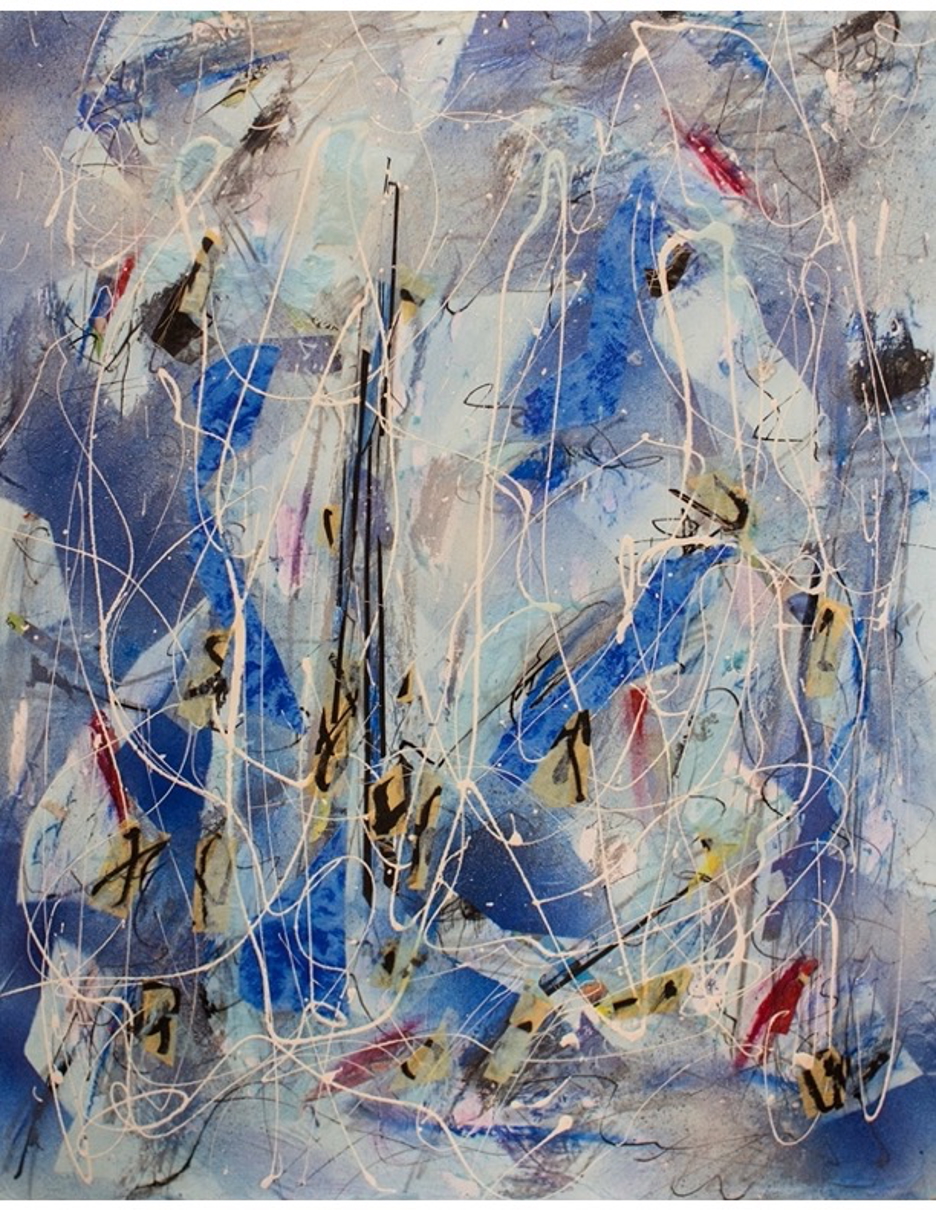
I was lucky to represent Paul. Ever since his show in 1997, his paintings had a steady market and commanded a good price; he had been “discovered.” By 2001, he had saved enough to purchase an old homestead 250 miles north of the city. How he found it remains a mystery. The first time I had trouble even finding the macadam county road, double letter designation, never mind the dirt path hidden behind a birch grove. It wandered a half-mile to his property: two old buildings at the bottom of an overgrown valley.
Paul had been painting abstract landscapes using everything from acrylics to watercolors so I understood why he fell in love with the location; he was now truly immersed in his subject. He told me that it was like living in a happy valley. However, both the old wooden outbuilding and the two-room “house” left a lot to be desired. The unheated outbuilding he had converted into a studio but could use it only when it was warm enough to hold a brush, perhaps 6 months out of the year. I had to dissuade him from putting in a wood-burning stove; the place was a fire trap.
The old farmhouse was only a little better – the original homesteaders and their heirs never bothered to put in central heating or get on the grid. The third generation used it as a rustic retreat. I had cautioned Paul, but he was determined. “Larry, I’ve had enough of the city and it’s impossible to work there in the summer. Haven’t you heard about global warning?” I asked if he meant to say “warming” and he replied, “No, warning is the right word. Mother earth is telling us to shape up or she’ll burn us out!”
I couldn’t argue with that. And, besides, he promised to give me at least as many paintings as before. “Come visit me every couple of months. I’ll up your commission 5% for the bother. And you can take a picture of me on location – Paul en plein air. Those old dowagers or whoever is buying my paintings will lap it up.” He was right.
Finding his place the first time was tough. I almost gave up and I guess that if I never came, he wouldn’t have cried, just kept on painting and stacking one work behind the other. But it was a day in the country for me and he didn’t require any advance notice. “Worst case, if I have to run up to town, I’m never long. Like the sign says ‘Bentonhurst, pop. 613.’ Trust me, there’s not much to do. I leave lists in the grocery and hardware stores and return in two weeks. Once a month I make my run to the big box store. Help yourself to a beer and enjoy the ambiance.”
Paul continued to paint abstract landscapes but now favored watercolors. You could definitely see the impact of wabi-sabi over the last ten years; the scenes had become amorphous and the colors appeared to have fallen on the cold press 750 gsm paper as if condensing from a fog. But once or twice a year when I called, there would be a large acrylic with a nightmarish quality. When I asked, he would shrug and spit out a remark like, “That’s the way the shit falls sometimes.” He took offence when I asked if I could help, so I stopped asking. Since they were selling well, neither of us had reason to complain.
Five years went by and then he asked me to come just twice a year. “June 1, I’ll give you the spring stuff; November 1, you can get whatever. I’ll leave them inside the house in case I’m not home. Leave me a statement and a couple of thousand in cash, nothing larger than a twenty, people are funny up here. The balance you can put in my account.”
He was becoming more reclusive and was often out on one or both of the days I came up. A torn paper bag, with his titles – mostly some weird numbering scheme: 2A 31 b, 2B 32 a – along with a minimum price, was on the floor in front of the paintings inside the door. Surprisingly, his prices were on the money. And then for two years, the list, the paintings, but no Paul. The last time there was another torn bag with a note saying he was taking some time off. Not to worry. He’d get a note to me in the city when he had new stuff: “I’m moving in a new direction and it may take some time.”
I knew he wasn’t hurting for money; in fact, he was sitting pretty even if none of the paintings we had in inventory ever sold. So I left him alone, thinking temperamental artists. Two, three years passed without any note. I wasn’t really worried. Paul seemed to have shrunk in size those first years on his homestead but then I hadn’t noticed any further changes. Maybe he had lost another few pounds and was hunched a little more, but he kept his intensity and color. I just assumed he had a winter studio somewhere warm and maybe another agent for those six months. Didn’t feel as if I had to get bent out of shape. He did well by me and I did well by him.
Still, I was a little concerned. I remembered that the studio and house had at best only received a minimum of maintenance over the years. Probably the only thing he did was to have a neighboring farmer come in and cut the weeds and lawn surrounding the buildings. I recalled that there were a couple of plowed rows with vegetables behind the house on the south side. There was ivy growing up the sides of the house and shrubs seemed to be crowding in on the studio.
The Wednesday after Memorial Day I decided to drive up north and see Paul. I felt we were old friends and since a couple of his paintings had recently sold, I had the excuse of wanting to drop off some cash as in the old days rather than putting all the proceeds in his account.
The road leading in was as before – a road less traveled – but I was shocked as I came around the last bend and saw the house. The fields were overgrown, indeed they looked as if it had been a year or two since they were last cut. Vines now covered several of the windows and one tree had fallen across the front of the studio.
I parked, walked around the house and studio shouting out, “Paul, are you there? Paul, are you home?” I felt foolish but went back to the car and blasted the horn several times, making enough noise to wake the dead. Then I went up the two steps to the front door and banged loudly. I tried the door, and when it creaked open, entered as in the old days.
That probably was a mistake. The air was rank. I looked around. There was neither a rock holding down a note nor a stack of paintings standing behind it. The front room where I was standing was a combination living room/dining room with a primitive kitchen off to one side. The bedroom was in the back. I turned on the flashlight on my phone and walked across to the bedroom door, which was half ajar. I stood inside the doorway and shined my light on the bed. Paul was lying there covered in spider webs. I retreated out the front door and retched, holding onto my car door.
I had to drive back out to the macadam to get a phone signal and call 911. Thirty minutes later a sheriff pulled up, listened to my report, and then asked me to drive with him back to the house. The rest played out as if it were on TV. Eventually, I had to follow the officer to the county office and fill out a full report. It was late when I finished, and I was in no shape to drive back into the city. I got a recommendation for a dinner club and a clean motel and spent a restless night, wondering if Paul had painted himself into one of his abstract landscapes.