I came to scuba diving during my last term in college; needing a credit or two to graduate, and my major (philosophy) was complete, just a few short months and a few essays stood between me and my diploma. Together with a couple of other slackers, we perused the spring course offerings and saw – toward the back of the alphabetical list of classes under “S” – that scuba could be earned for credit. The classes would be held at the school’s gym in its grim and frigid cinderblock pool; and the open water final exam at one of the local lakes. This being western New York, amongst the glacially-carved Finger Lakes, whose waters have not warmed much since the last Ice Age, we were suitably chastened at the thought. We signed up, dutifully studied our dive tables, splashed around in the pool for a few weeks, and then were ready for our final open-water dive.
By early May, the deep waters of Lake Skaneateles were still barely liquid form, maybe 34 degrees Fahrenheit[1]. My memory is that we had to gear up in wet suits (not nearly thick enough), submerge to two atmospheres – 66 feet for a certain amount of time called for in the dive tables –, and then log our times at various depths before we returned to the surface. When I and my buddy stumped from the lake, burdened by the heavy gear, I felt nothing below my knees and elbows. We admitted our testicles were likely tucked safely up in our abdomens. My hands and feet were still at the ends of my limbs, but they were not mine. They seemed to belong elsewhere, unconnected to my mind and nervous system. Peeling off the suit and gear proved virtually impossible, facilitated by our laughing instructors; our naked limbs gray and corpse-like. My teeth chattered. Had I needed amputation or two, I would not have felt a thing.
It took days to warm up, but I and my chums passed the exam and were issued our scuba certificates, which, unlike almost any other license to engage in a dangerous activity (see, e.g., driving and flying), is valid for your lifetime; you never have to take a recertification as long as you live, provided you don’t lose your card. And this also makes you a member to an elite worldwide club.[2] Wherever you are in the world, if you want to rent tanks and gear, you flash your badge, and off you go – coral reefs, shipwrecks, lost treasure.
Here in Maine, the water is no warmer, even in the height of summer, than those frigid dives in the Finger Lakes. But I’ve done countless dives over the past 30 years, because breathing underwater is just about the coolest thing that humans can do with the help of science, short of shooting into space and walking on the moon. I still recall the first underwater breath I took in the pool. With the regulator in my mouth, I slowly put my lips under and breathed in; I did not choke. I was serene. I put my nose under, and breathed in. Death did not impose. I put my whole face under – looked around at the darker blue of the deep part of the pool – and breathed in again. I descended slowly and sat on the bottom like Subsea Buddha. A miracle!
I’m an unlikely diver, afraid of and ungainly in the water, and a terrible swimmer. When I try the crawl, I get water in my ears and nose and swim in circles. I’m skinny and tend to sink. I get cold easily. I’m terrified of being attacked from beneath by sharks or losing my breath and gagging and going under. When I was a kid, I would feel a form of alien terror when looking at the shadowy shapes of underwater objects. Pilings that disappeared in the murk, boulders that loomed, immense and sinister, with dark crevasses that suggested unknown evil. When I took my first swimming lessons in Lefferts Lake, Matawan, New Jersey, rumors of the “summer of terror” still persisted amongst us six-year-olds, some 60 years after the attacks.[3]
But when I pull on a thick wetsuit, strap on the buoyancy compensation vest, secure my mask, and feel the reassuring weight of the belt and tank on my shoulders, I become a kind of superhero – impervious to these terrors, real and imagined, capable of breathing underwater and ready for heroism.
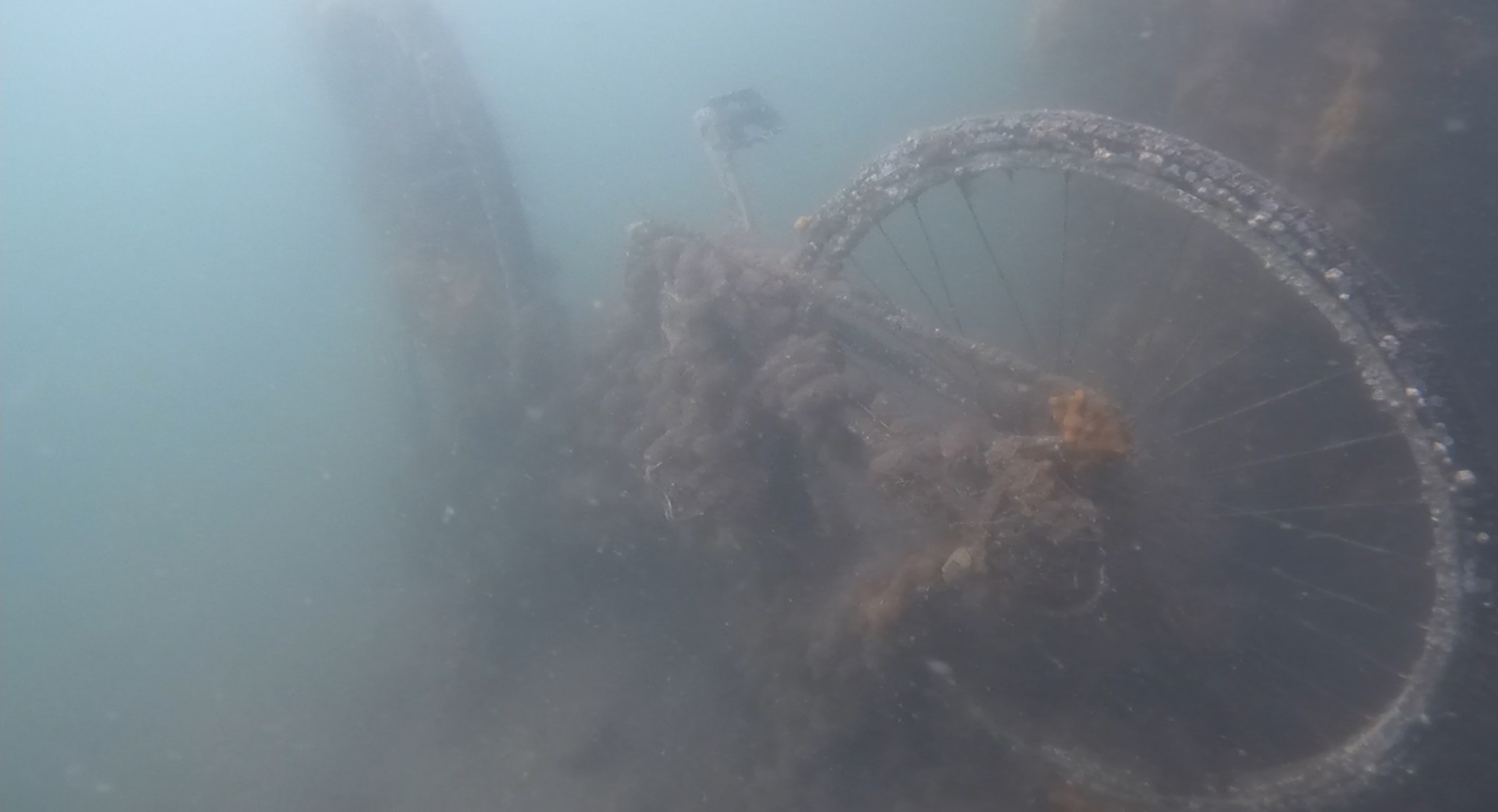
Which is to say that I dive for junk, or to cut lobster lines or fishing nets wrapped around the propellers of friends’ boats, or search for leaks in wooden planking. I have found coffee cups, those white and green CorningWare kind that used to be in every diner, skateboards, and many, many bicycles – some useful, and others resembling a specter of their former selves, covered in sponges and barnacles and algae but retaining a haunting bicycle silhouette as they loom up from the bottom. When a human-made object sits on the seafloor for a while, it attracts life, fish and crustaceans, and the seaweed and other growth waves gently in the currents, giving it a kind of beautiful, undersea second life.
Here on Peaks Island, Maine, there is often a rash of bike theft. Teenagers and post-wedding drunks, who pull an unlocked bike from the rack, carom downhill and shoot off the end of the pier, howling all the way. As a result, the bottom of the harbor at the end of the pier is a bicycle graveyard. As I descend – the bottom is between 25 and 35 feet, depending on the tide level – I see lobsters shoot past me, flicking their powerful tails and disappearing like backward missiles. Crabs stand their ground, claws up. Stripers and mackerel circle curiously in my periphery. I turn to look, and they’re gone.
One day this summer a friend asked me to look for her lost bike. A treasured blue Rocky Mountain that she’d had professionally sized. It had been stolen from her yard the weekend before, and she’d checked the usual spots that hooligans usually stash borrowed bikes, all the local teen hangouts. On a small island, there are only so many places to get into trouble. But it was gone, and she feared the worst.
Her husband Mark and I met at the dock early one Saturday morning in July, and I suited up and dropped off the town float. Visibility was terrible, maybe six feet, and a strong outgoing tidal current was sweeping the face of the pier. I started on one corner and worked my way across, swimming from the base of one piling to another, seeing a few bike skeletons long since wasted away and a smashed lobster trap. I swam back and forth, each time performing a zig-zag pattern so I wouldn’t become disoriented from the pier and end up in the channel. I soon came across a blue bike, lying on its side. I tied a quick bowline around the frame and gave the tag line two quick jerks, the pre-arranged signal for Mark to haul up whatever I’d snagged. I soon found another – a lime-green Felt – also not in bad shape. I came to the surface and asked if one of them were hers. Nope. What had appeared to be an adult-sized bike was a 24-inch kid bike, the magnification of my lens had made it seem much larger. Down I went again, losing hope, but committed to searching one final area, about 10 feet out from the ramp where bike thieves are known to launch when they’re at their most daring. If you get enough speed down the hill, and don’t hit the brakes with last-second misgiving, you can catch clean air and sail far out over the water and into the deepest water. And there it was, the unmistakable words “ROCKY MOUNTAIN” emblazoned on the blue frame.
Bowline, two tugs, and up it went. A freshwater rinse and some judicious oiling, and the bike was back in service. Mission accomplished. Until the next wedding or teenage rager.
[1] Not really. It was probably in the mid-50s.
[2] This is not true either. Scuba divers are one small step up in life form from surfers, whose qualifications, beyond a high opinion of oneself, is not even knowing how to swim but simply clinging to your board sufficiently not to drown.
[3] In 1916 there were four fatal shark attacks on the Jersey shore, including in the very waterway where I was taking lessons. I don’t know how this information still circulated amongst children in this area, maybe from sadistic grandparents. (“You know, Jimmy, when I was a kid four people were killed in that creek.”)