Mount Desert Island hovers in my consciousness like Maine hovers over my home state, Massachusetts. It looms like a thought cloud in a cartoon— not quite attached to my daily reality.
Mount Desert Island doesn’t sound like a place in Maine. It sounds like somewhere a pirate ship washes ashore. It seems far away, though it’s only a four-hour drive north from where I live—far enough. Often I forget it’s there, but then it returns through the mists like Hy-Brasil, Avalon, Brigadoon, or Howl’s moving castle. Maybe it appeared that way to Samuel de Champlain in 1604 when he arrived at the coastal island that the Wabanaki Native Nations call Pemetic (“range of mountains”). Champlain saw the bald peaks of what is now Acadia National Park rising up as if from nowhere in the midst of the Atlantic. He was searching for Norumbega, a mythical city. He called the place Isle des Monts Deserts.
Really, it’s me who appears here every few years.
I came for the first time the year I turned twenty-one, and again at twenty-five, and again at twenty-eight, twenty-nine, thirty, thirty-one, and, now, thirty-five. Each time, it’s a slightly different me who comes with a new job, new ambition, new anxiety. But the same person (almost) always is with me, Pete—my boyfriend, boyfriend, boyfriend, and, now, my husband.
We’ve been here in the town of Southwest Harbor for more than a week. We rented an old house with wide knotted floorboards and exposed beams—right by the sea. It’s the first time we’ve been able to afford to stay for so long. It’s September, and the house lets the night drafts in, but the days are lukewarm, like a pot of soup with the lid left on all day. The mornings are wet and thick with mist.
And I feel like my body is failing me.
I wanted to hike for days, without stopping, without tiring. I wanted to hike up and down as many mountains as I could. I thought it was what I needed. We’ve never stayed on this side of the hundred square mile island before, and I wanted to climb new mountains. But every day I have struggled. My soft overwrought body struggles up and struggles down each peak. I am aching, and it’s not that good sort of aching that lets me fall fully and blissfully to sleep. It’s the sort of pain that keeps me up at night. It’s the sort of pain that begs me to stop. Is it my age? Or am I just that out of shape?
I’m frustrated with myself; Pete flies up the steep rocky paths like a mountain goat and only occasionally looks down to see me galumphing behind him. The concern in his eyes, the sunlight at his back, and his long uncut hair give him a disconcertingly Christlike air. I hate feeling like a burden, like I’m holding him back. I hate that I’m not enjoying this beautiful place. Or the person I love.
At night I look at the pictures of my slowly aging self, each time I’ve come here—like there’s some clue in these frozen moments. What happened to me, the college student, the sales associate, the administrative assistant, the gardener, the farmer, the florist? And what is happening to me, now? I drag my useless legs to the harbor, and glare at the fancy sailboats, as if my concentration will free them from being battered by the sea. I hurt so badly, I wonder if there really could be something wrong with me. But I’m afraid to believe it.
Pete was supposed to have another week off, but the real world has called him back. When he told me, I ran my tongue behind my teeth to stop the words. He can’t come and frown at the boats with me because the world beyond the mists, beyond the mountains, needs him.
Envy settles over me, heavy and humid as the mist.
Pete has always known who he is. At fifteen, Pete was an engineer before he could drive. When four interns at a local tech company left for college, Pete replaced all four of them. It’s not just that he’s always been startlingly brilliant. He loves what he does. It’s the love that makes him good. I can see it when he’s working on a problem: the pure desire to solve it. But I don’t want to be one of those problems.
I have struggled to find myself. In the past I’ve been distracted from what I really wanted out of life with the immediate necessity of work. But not now. Without my usual hustle, I feel like a wedding gift— a heavy, bone white, casserole dish: not useful in a day-to-day way, aesthetically benign, and too nice to throw away. I’m lucky, I know, to be free—privileged. But maybe I wasn’t built for this kind of luck.
The retreating tide rushes through the wide stream in the sand that separates me from the path up to the Great Head Trail. The stream washes all the way to the sand dunes to my left. To my right is the sea. In front of me the small peninsula of Great Head peers out of the coast like a shameless looky-loo spying on a tiny island. The island—I know from the Acadia National Park map, is called Old Soaker.
The still rising sun retreats behind a cloud and the pink granite cliffs seem cloyingly rosy. It’s a steep trail up from the beach. I am below the trees, below their roots even. As I draw closer, my steps are slowed by the sand. The sun is obscured completely by the cliffs. In this cold and sudden shadow, I have the brief sensation of being in the underworld.
I’m not alone here. Other people, other dogs, other kids, mill on the beach like sand fleas. Their voices rise above the crashing waves like harsh whispers over a church organ.
They don’t know what I’m feeling.
I cross the small stream, and my feet sink into the sand. Old Soaker, I think while wishing I had worn real boots. My thread bare sneakers seemed like enough for the job. The wet September air, palpable, almost potable, is an extra burden. My skin feels damp even inside my raincoat.
And my legs are still crying out in protest. Hiker after hiker passes me as I feel the sharp response of every footfall. I have no reason to try and keep pace with anyone, but I lumber up the slope feeling leaden—only half begun, and already depleted.
The path crests at a crossroads. Self-consciously I pat my pockets for the map. Trim little people pass me: people who are probably running a marathon next week, people who have the right kind of shoes, people who have visible clavicles. Tough chitinous bodies pass me while I wriggle moistly in place like a grub. The sweaty paper from my pocket reads like hieroglyphics, and its meaning melts before my eyes. There’s no way I could really get lost. It’s a tiny loop path.
And I’ve been here before.
The path levels briefly before returning to a steady climb. A zealous dad with toned, hairy, calves zips ahead of his kid laden partner, as if he’s late for a forgotten appointment. Someone else with gray pigtails who sounds like a schoolteacher quizzes her friend. “How can you make a bucket of water lighter without removing any water?” she asks. Her companion nervously thumbs the straps of her backpack, like this is a real test of intelligence. Somehow, I can’t bear to hear her answer. I push my pace, hoping to pass them, and the effort winds me.
I stop, step away, and let the stream of bodies pass me by.
Was I always like this? Was my body always so heavy—did I always feel so heavy? I’ve had a recurring dream since childhood: I run down a hill, so light on my toes that when I come to the end my feet leave the ground, flying. Was that feeling ever real, have I ever really felt it?
I slink into the trees, and onto a small path of pebbles and gravel ground to sand by hiking boots on the boulders. Blueberry bushes push through pale lichens piled up like snow. The leaves of the blueberry bushes are touched with the red. I pick one of the leaves and pop it in my mouth, chewing it gently as I walk. I know that it should taste sharp and green, but my mouth is dry—I can’t taste anything. I run my hand up the top of a small scrubby spruce tree like the tail of a dog. I sniff my palm, and the piercing scent clears the inner mists for a moment. My eyes water, and I can’t tell if it’s from the wind, the spruce, or something else.
Beyond me is the cliffside. The wind, free of the trees, whips my hair out of its headband. I’ve bleached it so many times, like the pigment might somehow be weighing me down. Now it’s breaking free, flying everywhere. I step closer to the edge. The sea roar is too loud now to be pierced by a hiker’s voice. I could scream if I wanted to. I look down, watching my feet as if they might overstep the speckled granite, and fall into the sea. When I look up, I can no longer see solid ground in front of me. The mist blurs the line between water and sky. The pain in my legs has left me. I can’t even feel my heart beating. The wind on my skin is the only thing that reminds me that I’m still a sweaty creature full of guts and messy feelings. I’m a rock piled on the edge of the land: silent, solid, salt kissed, clammy and cold to the touch.
I will be here forever.
It doesn’t matter how many times I have hiked around Great Head, the place never seems to stick in my memory. I can never remember how long it takes to hike, or how far the loop walk is, or how steep the slopes are. I remember that the views are good, and it doesn’t take too long—a hike you can add on when you’ve already hiked too much. Those are the things that I remember before I’m there.
When I came to Mount Desert Island for the first time, Pete was newly graduated and coming back to Massachusetts from New York State for a job. I was trying to transfer out of my large state college where I was getting lost—swallowed, really. That May was a dead zone. Pete’s job wouldn’t start for another few weeks. I had finished my sophomore year, but hadn’t heard back from the schools I had applied to for transfer. The train of our lives had stalled, and we had no choice but to look out the windows and see where we were.
And we needed to catch our breath. Pete had nearly died of a blood clot, in the first weeks of my freshman year of college. I drove home from college after only being there for a few days. The first time I saw him at the hospital he was wheeled by on a gurney surrounded by nurses. He was crying out with the pain. That was the first time Pete’s parents told me to go home. As Pete’s condition grew more dangerous my parents begged me to go back to school. I missed the first two weeks of my freshman year. I wouldn’t leave. To me there was only one option: to stay as long as Pete wanted me there, and he said that he did.
One night in the hospital, a nurse roused me from my sleep in an uncomfortable chair, and told me matter of factly that Pete’s condition was unstable. His parents had gone home for the night, and were on their way back. I was afraid to go back to sleep, like my own loss of consciousness would give Pete permission to leave this world. I stared at the veins on his hands and willed the blood in them to keep moving. I watched doctors and nurses jostling and injecting.
Time seemed to slow down, and Pete’s death began to feel inevitable. All at once it occurred to me that, a hospital was a strange place to die—with beeping machines, the smell of plastic, antiseptic, and half-washed bodies. Shouldn’t he have been laid out somewhere as beautiful as he was, and allowed to slip away into the earth? At a loss, I prayed, angrily, and I didn’t know who to. I loved him. I wanted him to stay with me.
“I don’t want him to die,” I told the nurse.
“I know you don’t, and I don’t either, but I don’t want you to be unprepared. You’re not the first little girl I’ve had in here, you know?”
I was eighteen. It was the first time that I thought I might be too young for all of this.
I gave way. When Pete was perched on the edge of life. I ran away, for a while, unable to stand my ground anymore. When Pete’s parents returned, we argued, and I left. I understood that I was an unwanted complication as they tried to care for their son. I couldn’t go home and face my parents, so I walked stiffly through the cold hospital light and outside to a dark garden. I lay face down on a stone wall. I though, selfishly, about how by tomorrow I might be a dead boy’s girlfriend.
I could finally cry.
We both survived, and for a few months we could pretend it was all some fluke, like a car accident—a close call. And then, we went through it all again that summer when Pete had another blood clot.
I tried to adjust to life at school but, in addition to missing Pete desperately—like if he were out of my sight for a second he might slip away, I felt like every adult in my life had failed me. I just couldn’t see how graduating on time was so important, in the face of life and death. A high school bout with mixed eating disorders metastasized and mixed with other coping mechanisms. When the hunger pains kept me awake, I would drink and take the pills the campus health clinic gave me until I could sleep. It was a symptom of a deep undressed wound. I couldn’t recover from the first major hardships of my life.
I hoped I would never wake up.
When Pete suggested the trip to Mount Desert Island I was terrified that he would see how broken I was.
In 1947 a fire destroyed much of Bar Harbor and the surrounding wilderness. Earl D. Brechlin writes in his pocket guide to Mount Desert Island that “all the vegetation on Great Head is still recovering from the effects of the Great Fire of ’47, which blew itself out in a great wind-whipped fireball that leapt from the head and extinguished itself out over the ocean.” The fire had burned all the trees, all the grass, all the moss and lichens—everything back to its bare essence. Brechlin wrote his guide to the island in 1996. I don’t know if Great Head is fully recovered, or if we will ever know when it is.
I step away from the cliff side and I’m startled by a single blue flower growing out of a crack in the rocks. It is so blue against the gray that it looks like a hole in the clouds. I can’t find another one nearby. She’s there alone. The seed that she grew from was dropped long ago by some bird or blown in by the wind. She was left there to struggle into bloom, I want to capture how blue and how lonely the flower is against the gray sky and the cold stone. I lie on the ground to try and photograph the flower, but she flails too wildly in the wind; the camera won’t focus.
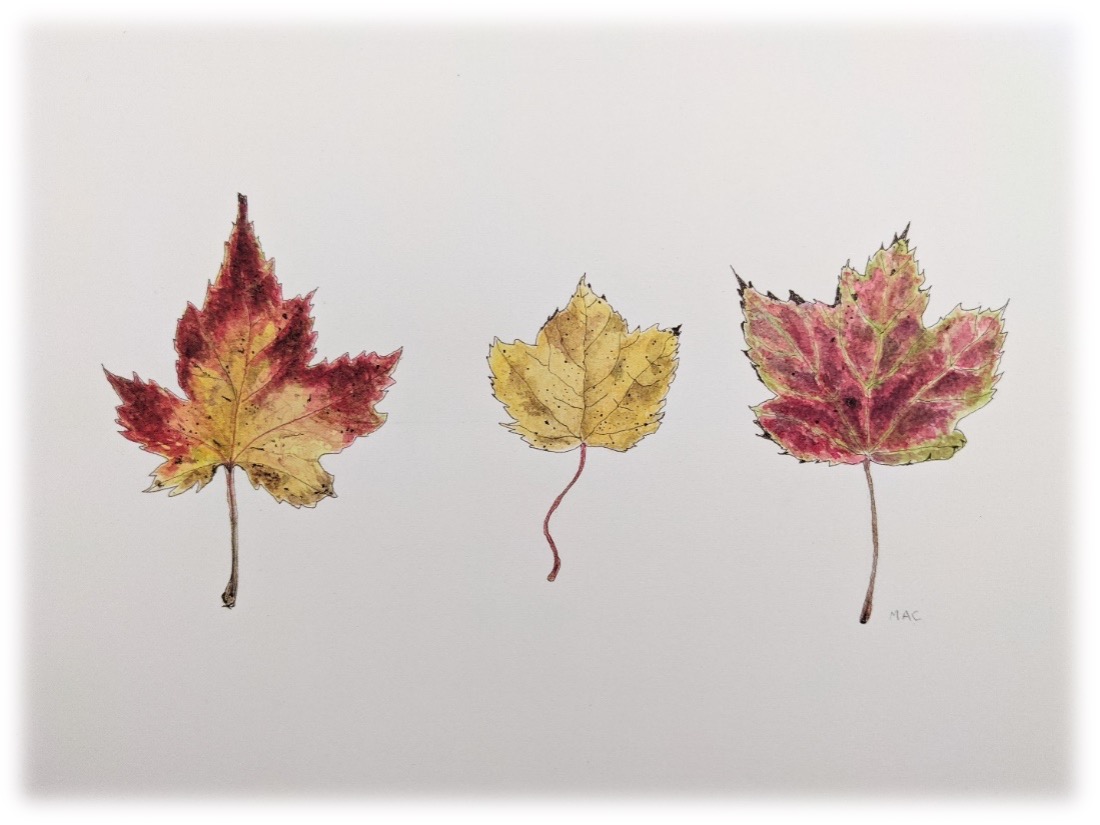
In time I rejoin the fray of hikers. I’m not looking out at the sea anymore. I can look back toward the island, now. The maple trees are turning scarlet in the low places. From here I can see the beach bellow me, and the people milling around taking pictures of the yearly dying. When I came here a week ago, all the leaves were green. The change happened gradually. I noticed one leaf brushed with red, it’s veins still green.
As the chlorophyll in the leaves is depleted other pigments, formerly masked by the brilliant green, come forward. Soon all the brilliant reds in the maples, the gold in the paper birches, and russet browns of the oaks will be revealed. The leaves have this intense moment of brilliant brightness before they fall to the tree’s roots. They fall to the earth and are eaten up, bit by bit, by tiny organisms. But the tree lives.
Autumn has caught up with me.
When Pete was in the hospital he couldn’t shave, so he grew a beard. He hasn’t shaved that beard in fifteen years. I forget what his bare face looks like. There’s gray hair in that beard now, and at his temples. I forget that he has changed too, and there’s no version of him I couldn’t love.
Besides the beard, the regular tests to monitor his blood thinners are the only reminders of his sickness. But, somehow, I’ve never been able to fully let it go—let the lessons learned inform my life in a practical way—like I’m supposed to. I’m still angry. The anger hovers in the back of mind, and then, sometimes, the bright and brilliant pain of it comes flooding back.
Pete chose this place for us to recalibrate: him from his double brush with death, and me from my slow self-destruction. On that trip, Pete took a picture of me on Great Head staring out at the sea. Last night, when I looked at that photo again, I didn’t see the depleted ghost that haunted my insides. Today I realized that she’s been here all along.
I’m afraid to be sick. I’m afraid to need help.
The mountains loom beyond the beach—the hikes I’ve done before: Gorham, Cadillac, The Beehive. It’s enough to know that they’re there. I don’t need to climb them again. Not today. Their peaks are hazy—in the clouds, and for once I’d like to be able to see for miles uninhibited.
But that’s not the kind of place I’m in.