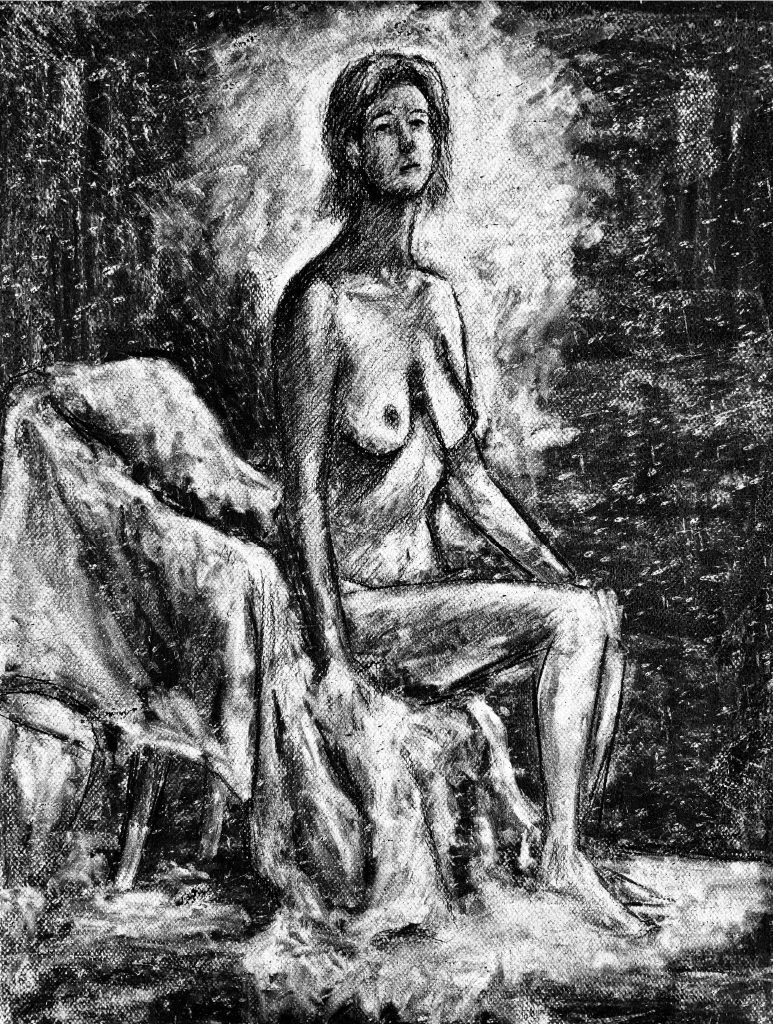
I lived in a loft overlooking Boston through a wall of glass. I won’t tell you where. Don’t find me. I lived in a loft overlooking Boston, and the only way to get there was by either freight elevator or a ten-story stair. And I thought at the time of signing that lease, surely, I wasn’t the only soul who’d live in such a loft—not too expensive for what you got. My apartment was this room, and the bathroom, and on my floor there was only one unit across from me, and not long ago the neighbors vanished. I used to hear through the walls. A couple, half-young. She was rich, and he was a kept-thing, and I always thought that was nice. They left, and I don’t hear anything anymore.
There was a statue I made some ten-odd years back when I was experimental. Now, I was just me. That statue I made still stood in the Museum of Fine Arts—it was simple, Homoerotic. All statues are a little sexy because something’s either hard or getting there. My studio apartment was built around large-scale ceramic. I put music on, some pretentious string quartet, and stretched out the canvas. It used to be I’d turn down the volume when the neighbors’ noises came on. I passed the neighbors in the hall once. They smiled at me. I smiled back. Good neighbors, good fences, and all that.
I brought the boys around. I brought the girls. I stripped naked and stood to the city skyline, proffering all my juicy bits to heaven. People were made to live on in stone, yes, and I liked marble well enough. That statue I made, still standing at the museum, that was marble. I was a real artist after that. Nowadays, I hauled pallets of clay up the freight elevator and hoped to pass by something smiling.
When the neighbors vanished, I had someone naked on a barstool say, Hey, I like this pretentious string quartet. They said, Hey, Did you know M is coming back to town? They said, I have to run, and I’ll be back, and would you please hand me my pants? I asked them to stay. Please, talk with me, moan with me, fill my rafters with sound, but they left all the same. They always leave. I took their earthy body and ran it through the pug mill. I woke up with ceramic dried to my sheets.
M was back in town, not yet, but soonish. They had an exhibition opening at the museum. M did statues too, but you wouldn’t sleep with them.
The old exhibition I loved—Arnaldo Pomodoro, an Italian futurist sculptor who said, What if there was a big, shiny sphere, but it was fucked up and at the Vatican? My favorite thing of his was simply his name: Arnold Tomato. I wished my name was something like that, like produce. Figs. Ole Figs, they’d call me. Mister Tomato, I loved.
M texted me without punctuation, and I was always like, What am I supposed to do with that? M wanted to get together because I was a Local Artist, how cute. I had a statue, and they had an exhibition. They wanted me at the launch. As far as I knew there was nothing more tragic than an artist who could feed themselves. I said I would be out of town.
There was an artist’s retreat—something this collective in Somerville did to inspire casual artists to get away for a week or two—and I was on the emailing list. How my email got there, couldn’t tell you. I shaved my head to look cuter and more pixie-ish and less 80s Rock. Bought new glasses too because my squarish black rims made a tabloid headline, and I saw these gold wire frames wrapped around octagonal lenses and I thought, Yeah, I’d change my personality for that.
The retreat: it lasted a little more than a week and we lived on a tiny campus with a café and a tiny yard and a horizon line of pine needles you couldn’t see over, but that looked down on you. Our rooms were dorms that looked unchanged since the 1950s. Quaint and squat and white, and the mattress was thin, but the poof still welcomed my buns. I got new clothes. Baggy jeans and light fabric button-downs, whites and pale purples and pale greens, and one pastel bitch half-pink half-blue jumpsuit that had me walking around like a gender reveal. Not my usual flair. At home, I was in black or in nothing.
That first night, there was a welcome ceremony. I didn’t give my name when we went around. I didn’t give my name when I signed up. I wanted to go by Arnold Tomato, but that too, I thought a glaring tell. I told them Tom Arnold and if anyone asked if it was short for Thomas, I’d tell them Tomato and we would laugh together. I had pieces, well-known pieces, tasteful fig leaves and busts, and juicy bits all over this rock and I didn’t want to put off any beginners. I’m so good at friends; it’s uncanny.
There was a little dining hall to match the little garden and little café and little studios and little everything else. We could eat all our meals together, or not. If we wanted, we could write a little note to the not-little staff, and they would leave a basket outside our doors. We had a couple rows of tables at the mess just for us. Our cohort numbered twenty. Plucky undergrads here on the recommendation of their professors, determined septuagenarians finally working with their hands, and cowards. I was straddling my early thirties and the people to my left made me feel a grave and the people to my right had me feeling that cradle.
Beside me though, sat a girl named Louisa, no more than twenty-two. Brunette, hair cropped to her shoulders and a tattoo of a sunflower under the strap of her tank top. In those brief moments at the table, she had introduced herself, or rather re-introduced because we’d gone through it all at the ceremony, and she used a spoon to shape the rice on her plate into a smiley face. I turned to her and said, Hi, I’m Tom. Ole Figs, I’d’ve said if I wasn’t scared.
—Sculptor, are you? I asked.
—Tryna be! she said. Her words themselves had a grinning oeuvre to them. She was cute in a dictionary definition kind of way, and I thought what I always thought: Hey, maybe this could be something. I had to stretch in the mornings now, but maybe we could overcome that.
—So, you’re into sculpting, what else you like to do? She swallowed a laugh down with some rice and asserted:
—I’m actually really into axe-throwing.
Hell yeah, hell yes. It was not long after my follow-up questions that she mentioned the boyfriend. My boyfriend and I started going to this axe-throwing gym a couple months ago. I didn’t want to be one of those people who, in that instant, lost interest in the conversation. Hey, if I didn’t like couples, I didn’t like anyone these days.
Family members, friends, could come and go as they pleased, but if they ate, they needed to pay, and if they stayed the night, they weren’t allowed to, but, mostly, it was just us. The teachers came from fringe Boston circles, from the local Universities, and, for the exceptionally worldly folk, some of the teachers were from both. None of them I knew, personally. Some I had known of, sure, which made me believe they had heard of me. I didn’t have anyone to visit, which I was fine with, I was. It just meant that when we got to the studios—reclaimed brick buildings, one even with an ancient bottle kiln reaching against the sky—I stuck with Louisa.
—Do you mind the company? I asked.
—I welcome it.
Early on the first full day of the retreat, we set about the ceramics studio. Rows of canvas-topped worktables at the room’s heart. Everything dusted with beige. Resplendent. I took a tired wire tool from a hook. The instructors were there if anyone had questions, and Louise the ever-confident, took a lump of brown clay from its plastic-wrapped block and sat down, started molding. I grabbed an extra needle tool, an extra cup of slip, and set it down beside her. She regarded the artifacts like one did a jigsaw puzzle seconds after spilling the pieces onto the coffee table.
—You have to wedge it, I told her. It’s like kneading dough, and you have to do it unless you want an explosion in the kiln.
—A literal lifesaver.
—I do my part.
We had stoneworkers, metalworkers, woodworkers, all kinds of work among our numbers. Out in the hall, you’d hear the machinations from the other studios. An adorable clanging and sizzle from the metal shops, the whirring of sawblades and woodturners; only took an hour before someone went out to the infirmary. The cohort broke for lunch, but I worked through it. I wanted a hug in clay. Two vague lifeforms with four ambiguous arms wrapped around each other. The clay instructor came around and told me that it reminded her of U—‘s work and asked me if I had heard of them. I said no, even though it was me. When she turned, I brushed the WIP off the side of the table, gray-brown slip ran over the imperfections of the floor like murky blood.
Louisa came back from lunch and What happened all over the clay when she saw me re-wedging the piece. I smiled. Accidents, you knew how it goes.
—What are you going to do with that? I asked Louisa. It was the second day, and I hadn’t even seen she’d neglected the slip part of score and slip. She was making a cat, simple enough.
—Oh, it’s for me, she said. We’re moving into a new apartment soon.
That seemed to be the week’s flavor. I met Deb who was sixty-six and learning how to work a lathe because she wanted to make a chair that matched her father’s old dining set. I met Xiao and his boyfriend Grant who were throwing respective parts of a birdbath for their garden. When I asked them if they would ever show it, ever enter it in a contest, I was met with cocked heads. No one had heard of contests for birdbaths and chairs. How could you not have heard of contests for birdbaths and chairs?
Louisa called out to me night of the third day. I couldn’t get away from time. It was always noon of the second day, middle of the fourth night, end of the first week, I couldn’t simply be on time, I had to be regimented. I wanted to melt into a clock, have it dissolve in my gut so I could shit it out, or it shit me. I didn’t want to know time was moving; you never want it running out. But, Louisa called to me.
—Tom! She shouted. There was a little bar that matched the little café and little garden and little baskets, and we sat around every night a bowl of beer nuts and pretzels with a glass of wine, and I just knew that one more stiff pour of Malbec and Deb’d tell me if her husband was her first lover or if it was some other memory that made her face a pure crimson. Tom, Louisa said, this is my boyfriend, Tommy. You have the same name which I hope won’t be confusing.
—We can find a workaround for that, I said. I shook Tommy’s hand. He was cute in a dictionary definition kind of way. A shock of brown hair, a flannel button-down that was, perhaps, a half-size too big, and he had those lines around his mouth. Those lines, the giveaway that we had a smiler in our ranks. A laugher. He hunched forward slightly, and his hands were calloused, and I wondered if that was for axe-throwing or if he had other brilliant lives waiting to be unpacked.
—It’s good to meet you, he said. Lou tells me you’ve been watching out for her in the studio. I’ll probably need your help too, come tomorrow. I couldn’t get away from work for the first couple days.
—Dental hygienist? I guessed.
—House painter, but who wouldn’t be opposed to teeth now and then?
I didn’t know why Tommy added the last bit. And, from the gleeful perplexity on Louisa’s—Lou’s—face as she looked up at him, I knew there that none of us knew quite what Tommy meant. How brilliant it was. I loved that his words came first and sense, not second or third, but fifth. I wanted you to speak, then feel, and then, years from now, then I wanted it all to make sense. I handed Deb over to Xiao and Grant, which Deb loved as if she had a punch card, and for every twelve gays she got to know, there’d be a free sandwich in it for her. I bought a bottle of white from the bartender and told Lou and Tommy that I didn’t care what they normally drank; We were all Pinot Grigio that night.
Here's how they met. It was food poisoning. A Panera Bread, of all places—it was a cheap place for some friends to share a meal before a hockey game, no, a baseball game, no, a hockey, well, it didn’t matter because no one went. Lou and Tommy both got that cheddar broccoli soup and that was enough to pique each other’s curiosity because it was the night they met. Everyone else had chicken in some way or another and they were all piled into a shuttle crossing town when six, seven of their friends checked their glut and clutched their guts. Involuntary shepherds, Lou and Tommy ushered their friends to the nearest of their apartments, a train of farts and vomit along some city sidewalk in Maine. They assumed the roles of wardens and gardeners, keeping watch and keeping watered. I poured them both another glass. We sat in the warm late sun. Humid, without bugs, perfection. It was a fun enough story, but I realized it wasn’t the conversation that drew me to Lou and Tommy. Frankly, their analogies were not tight and their lessons-learned, fairly prosaic.
No, it was the way they looked at each other when the other wasn’t watching. They stole glances like kisses. When the bottle was empty, Lou offered the next round and, as she walked away, Tommy said to her:
—My fraaand.
It was a call and response.
—My fraaand, Lou returned. He reached out his hand. She accepted while still walking away, their fingertips were lazy hooks, knowing that even this short goodbye was still a goodbye. Frand, they called out. Like friend, but with a Fran Drescher thrown in the middle there. She came back with three glasses, and I paid her with promises for tomorrow. She kissed—a short, lovely peck—the top of her partner’s head. They had not quite an electric intimacy. I looked at them and saw kids deeply caring, that even a more engaged kiss, a squeeze, a pet name even, would exclude me from the moment. Me. I came to take it that you didn’t do that to your frands.
The hour drew late. I didn’t want to hobble back to the dorms just yet. Some of the instructors were still pounding them back, but Deb, Xiao, Grant, they had long retired. I offered that, as the night became a chill, Lou and Tommy and I sit down with the teachers, but, looking back, I saw them—eyes locked—as Lou cupped Tommy’s hands in hers, pulling, inching back to the dorms. I then thought, hell, it must’ve been at least a few days since they saw each other. And they were twenty-two—it must’ve been an eternity and their juicy bits were yearning. I caught them in a question of between being polite and staying or going back and sleeping together. So, I withdrew the offer. I got another drink with the instructors, but I told Lou and Tommy to get some rest. I watched their excited little asses hustle across the little yard back to the little dorms. Now that. That was a statue.
I went to bed that night harder than I’d been in a long time. I was embarrassed, newly embarrassed, like I was a teenager again, and it was the middle of the date and oh, God, we had to walk from the Applebee’s to the movie theater, and what if they saw me reaching out against a zipper? It was something I’d hoped to have conquered by twenty-five. By twenty-five, if they saw me hard on the date, my eyes posing the question, Oh, God: How about you and me skip the movie? My place isn’t far from here. I lay there on my thin strip of cloud in my 1950s dorm room. Staring at the dark, I wondered if I missed my long hair or if choirboy was who I was now. I listened through the wall, wondering if I would hear sex—moans, giggles, and box springs; I wanted to hear a head bang against a wall they were too passionate to realize was there. I wanted to hear love as an act. I wanted to hear names called out through sweat. I wanted to hear my name, but no one knew it.
My lovers, that night, were hands and the moonlight.
Next day, it was the three of us taking up a canvas table. I tried making my hug again, my vague embrace, but trying to make it not like me. I wanted a present-tense me, or a future-tense me. I didn’t want the instructor coming around and saying if I didn’t know my own work, I should look me up. Tommy started out fresh. Lou had her cat statue and tried to mold whiskers, but it turned out producing a cat from memory was difficult when she’d never spent much time thinking about what cats looked like before. Tommy said he wanted to make a rabbit, or a boat, and when I offered a rabbit on a boat, it was a revelation. By lunch, they got silly.
—I’m gonna knock it over, Tommy said, pointing to Lou’s kitty in the mock-serious way of kids who want to be annoying for the bit.
—Noooo, she said, If you do, I’ll crush your rabbit.
—Not my cottontail!
Lou left for the bathroom. Tommy—he was never going to crush anything—Tommy reached over with a clayed pointer finger and drew a teeny smiley face at Lou’s workstation.
—You two have mischief in your hearts, don’t you, I asked him. I’d rarely met people like Tommy and Lou. They liked to needle at each other, harmless little jokes and notes, but the second another person joined the conversation, they had an almost anxiety about being kind, considerate. Made me feel honored that, when it was the three of us, they would drop the pretense and laugh like they had never left the playground.
—Oh, yeah, Tommy said. He finished modeling the ears of his bunny when I asked him if he’d wedged. He hadn’t. He was so proud of his rabbit, too. He crushed it under the ball of his hand and, in the time Lou was gone and he’d restarted, there came a problem with Lou’s whiskers. She was just returning when she hurriedly called out to us. Tommy and I looked up as the cat’s heavy whiskers pulled its head from its shoulder, tore the neck, and its face flattened on the tabletop.
—Okay, she said, okay. Tommy forgot his rabbits for the day. He and Lou set about a head transplant for the cat. But, the body’s clay was a day old and the new clay was unagreeable to it. After an hour, they were fatigued and ready to call it. Tommy had a fingerprint of slip on his nose, and when she tried to point it out, she managed to get some on her own. We all laughed, tired, and cold with earth. God, I wished they could see me. This was the closest I’d known such affection.
There was a bucket for recycled clay that Tommy dropped his rabbits into, but, at least, Lou had a fresh-faced cat with whiskers relieved instead of molded on, which left them with some security. Lou’s cat and my piece sat on the drying room shelves with the hope of getting fired in a day or two so we could glaze before the week was out. The teacher told me, it’s incredible how much your sculpture reminds me of U—‘s work. Are they not an influence?
What a weird question: to ask me if I’m an influence. We all scraped muck into opaque water and were left with our forearms.
—Drinks? I asked. But it was an early night for my friends. I got drunk with people I wasn’t as obsessed with. The clay instructor mentioned my artwork to the others, and they mentioned how much my artwork looked like my artwork. You should see them, she said, they have these glasses with these thick black rims—iconic.
—I’m sure, I said. I turned in early. Many people were, the fatigue of working, of flowing the creative juice, was plum-tuckering the artists out, but we all were happy to share our works-in-progress with each other. Grant and Xiao’s birdbath was on track for firing and glazing. Deb’s chair was wobbly but still good. Not bad for a first draft. In fact, most of them all happy to say, hey, not bad for a first draft. I missed Lou and Tommy.
Walked alone back to my room. Didn’t need to close out the bar every night. I did, occasionally, enjoy to dream. On my way back, I did pass some noises. The deep mahogany doors kept secrets, but the flimsy sheetrock was designed by gossips sick of getting news by holding a glass to their ear. The walls let everything through. Did you know how I learned which room was Lou and Tommy’s? As it happened, Lou was a grunter and Tommy a moaner and Lou a baby and Tommy a daddy, and they had more stamina than I had patience for waiting. I imagined a simple missionary, so they could look into the other’s eyes rather than stealing looks. There was the hypnotic percussion of the bedframe knocking against the stone windowsill. I timed my steps to it, my heart sinking with the fading of its definition.
In my room, I stripped my pale purples and greens and stood naked before my window. I saw brick buildings and the needled horizon. It wasn’t that I wanted to sleep with Lou and Tommy, no matter what my spent sheets said. I didn’t like them apart. I liked them as a circuit. And, no, that didn’t mean I wanted to be in the room. I didn’t want to be a voyeur because I always liked to get my hands in the paint, but watching them, hearing them, oh, why could I not be across the hall? They’re alive. They were just so alive. I ground against the bed for what seemed would last the rest of my life.
I woke up the next day with a message from M on my phone saying they missed me at the launch and that they were leaving Boston, hoped to catch up next time they were in town. Sure, yeah, okay. Tommy finally made his rabbits, and Lou got her bisque-fired cat and me, my hug. This was how it was as the week rounded out. We glazed our pieces. I walked away with something silvery and cobalt that I was happy enough to call mine. Tommy and Lou walked away with their non-exploded pieces, though Lou’s cat did have a crack that broke that cat’s head from its body. She fixed it with glaze.
—Figs, I said. It was the penultimate day. Noon of the penultimate day. I told them, you can call me Figs, it’s confusing with two Toms.
—Fig? Lou echoed. I figured it was close enough. I scribbled my apartment in the city down and told them not to be surprised if there wasn’t a Tom or a Fig on the buzzer. They hugged me in the end, one big bear. I told them to get out of here. It was a world too pure for them. I didn’t know how, but they had figured it out. They knew a secret I didn’t, and they kept it in each other.
—Be good, Fig, Tommy said. On the final day, the teachers offered us all bubble wrap for our pieces. Grant and Xiao’s birdbath had a crack that ruined the basin’s watertightness, and Deb had tried so hard to fix the wobble in her chair it was a half-foot shorter than the chairs she had at home. No contests for them, but they left happy.
The clay teacher said to me:
—You know, I like these glasses more than your old ones. You did great here.
As much as I didn’t want to admit she’d figured me out, I guessed she knew the whole time I wasn’t who I said I was. I never knew who I was, let alone who I said I was. I loaded my embrace into my rental and left for town, wishing I could see Lou and Tommy watch each other once more.
I took the freight elevator up ten stories. I looked down on a steel horizon. I put my piece in a box and hid the box behind a curtain. No one had moved in across the hall, still, nothing had changed in my absence. To the high ceilings of my loft, I called out: My fraaand.
It was ever quiet. I was alone and still unknown. I had a dream of then and there starting something new. But, no, I ordered a small block of marble online. I thought of calling M. Or calling Lou, Tommy. The sun went down, and the lights of Boston came on in a patchwork.
I stripped down, lay across the bed feeling the hollowness where a second body would fit, and I screamed.