1998 – 2000
Jesse liked working the lighthouse on Lake Champlain—nice to be a light no one needed. It felt silly to call himself a Coast Guard when bonfires winked from the New York beaches just across the lake.
The Guard had always been his ticket elsewhere. After basic and a college degree, he was stationed on Lake Michigan running lighthouses for six years—that got him out of Detroit. On the job he learned everything he ever needed to know: towed rich folks’ yachts when they got drunk and ran out of gas, picked up stranded fisherman, and even saved a couple swimmers caught in the riptide. He thought he might stay in Vermont after the assignment was up in two years.
He spent his whole life learning how to be alone—so Lake Champlain was perfect. The cabin he rented in Branburg was tucked away in a copse of pine trees, a ten-minute drive from the lighthouse. Come winter the trees would probably block the sun, but he would toss some pine needles in the fireplace and get along well enough. The town shut down with the daylight, even in the summer, so going to the lighthouse he was never burdened by unwanted interactions. The old couple who lived next door had invited him in the first time, but otherwise kept to themselves. The husband’s rowboat, “The Pinniped,” bobbed opposite Jesse’s cruiser.
Jesse kept watch through his binoculars. The lighthouse beacon swept across the water, beckoning the waves, that endless engine, to shore. The moon caught on something, and Jesse zeroed in. A boat headed for one of the tiny islands. Jesse watched it a while, before it disappeared to the other side. Something wasn’t right.
He strode down to the dock and started up the cruiser, but didn’t call in—just in case his hunch proved to be nothing at all. No need to act like a big fish in this little pond, he thought. Going alone didn’t bother him, no matter how much training cautioned against it. This preference, combined with a quiet refusal to partake in the usual pastimes during basic of drinking, smoking, and gambling, earned him the nickname “The Great Depression.”
The other newbies would tease, trying to engage him with the playful rudeness of false familiarity. “Why’re you so quiet? You a faggot who got lost looking for the Navy?”
He would smile at this, laugh, because if he didn’t they might realize they were right.
No one saw him if he didn’t want to be seen. In Branburg the nearest Coast Guard outpost was Burlington, forty miles away.
He killed the engine and let the momentum bring him in, so whoever was on the island wouldn’t hear him approaching, moored the cruiser near the boat resting on the bank, and slipped into the shallow water, flashlight cutting a path in the dark.
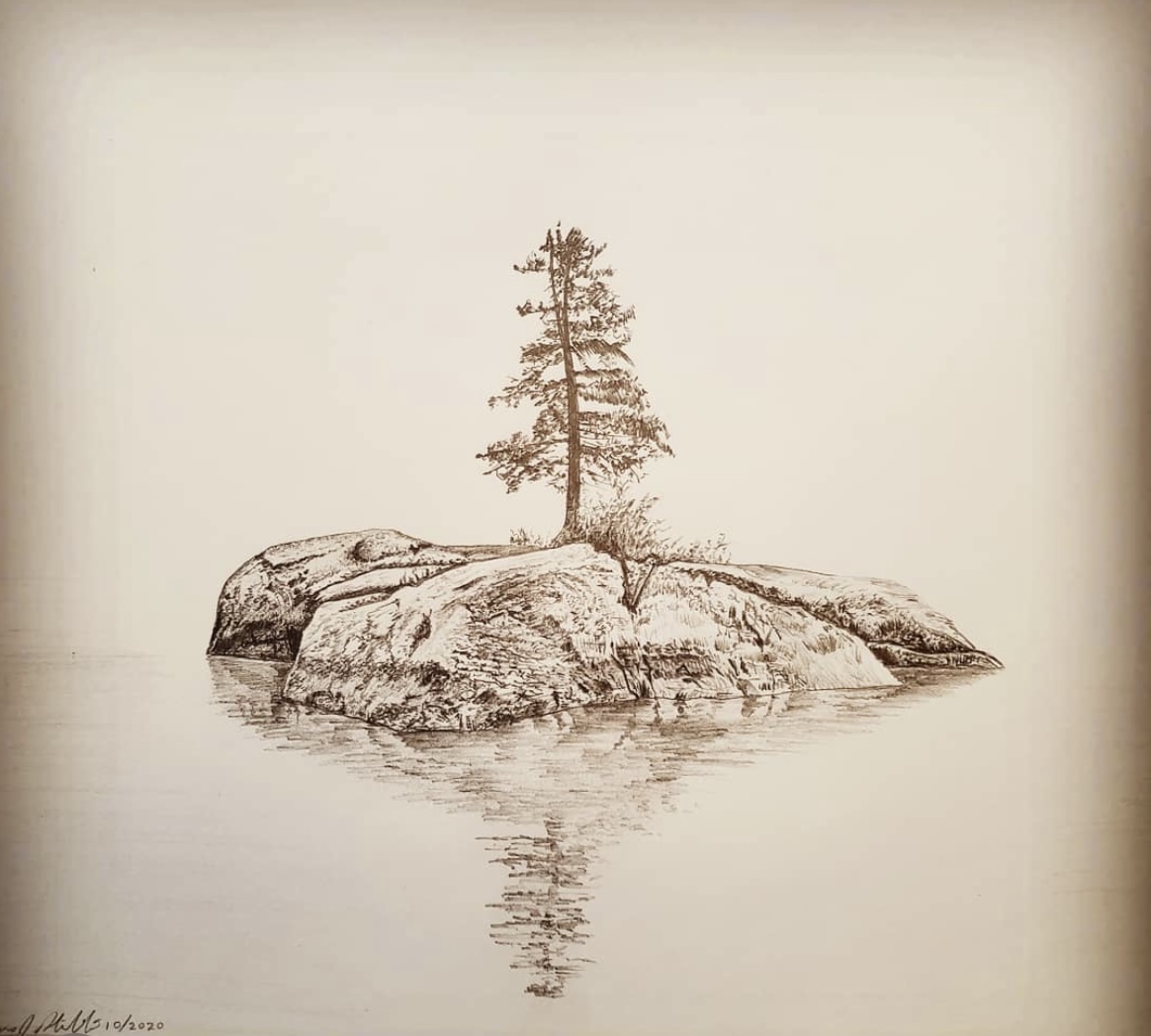
First, he inspected the boat. A small outboard motor—registration stickers two years out of date. Only one paddle, and no lifejacket on board. Shaking his head, he proceeded into the island’s brush. The buzzing cicadas and breathing waves masked his footsteps. The island was no more than a hundred feet wide, and twice that long.
Jesse paused, flipped his flashlight off, and listened. Something rhythmic was happening just ahead. An impact, a pause, a scrape, then another impact. Gently, Jesse parted the brush before him.
An electric lantern sat in a clearing, illuminating someone with a shovel. What in the hell would someone want to bury out here? Jesse wondered. Or what in the hell was worth digging up on a puny island like this?
Jesse still had some of the strength basic training beat into him. His adversary was scrawny-looking from behind. Just as Jesse made up his mind to tackle this person, his foot caught on a tree root and he fell face-first into the clearing.
The other guy reacted fast, spinning around and raising the shovel like a sword. But on the upward swing, the shovel collided with the lantern, knocking the light out. Jesse scrambled to his feet and lunged at the dark. In the tumble he lost his flashlight and as he cast around for it, the other man made his getaway.
At last, Jesse recovered his flashlight and ran after him. When he reached the embankment, the boat was already gone. Clambering aboard his cruiser he debated calling for backup. Well, he can’t have gotten far, Jesse thought, reaching for the throttle only to find his key missing. He threw himself back on the island and searched for it.
He found the key glinting in the underbrush, but by the time he circled the island, and scanned the shoreline with the searchlight, his quarry had vanished. Only the lighthouse winked back at him. Jesse knew he had an imagination on him, but not the hallucinating kind. He trolled up and down the bay for an hour more, peering at every dock, looking for the boat. Paranoia dug its teeth in, and panicking, he raced back to the scene of the crime. The boat wasn’t there either; the criminal had made his escape and wasn’t risking a return.
Jesse picked his way back to the spot. He found the lantern and the shovel and a hole a foot deep. Nothing else.
As soon as the town clerk’s office opened the next day, Jesse was there. A bell jingled as he walked in, though he couldn’t fathom its purpose since the building was so small you could see the front door from anywhere inside. Shelves of old newspapers and town reports dominated the lobby. A dusty American flag stood in the corner in front of a wrinkled map of Branburg. A middle-aged woman with dyed cherry-blood hair sat behind the desk, cigarette in hand, blowing the smoke towards a fan that faced the one open window. She looked familiar, and Jesse was about to shrug it off as another uncanny small-town quirk when he recognized her as the sole operator of the town’s dingy library. There was no name tag or anything, of course—everyone in town knew her name.
“Hi. Jesse Meiner. I’m new here,” he said. Jesse hated his name—the way kids called him “Messe Jeiner” in high school. “I’m wondering if you could help me answer a question.”
“I know,” the woman said.
“Pardon?”
“I know you’re new here.”
“Right. Well, I’m trying to find boat registration records.”
Without looking, the woman reached behind her and grabbed from a stack of identical books. She plopped one on the desk—“Town Report 1998.” On the cover was a black and white photo of twenty smiling kids holding eggs and spoons, captioned “50th Annual Egg Race.”
“It’s a good one,” the woman said. “I like seeing who hasn’t paid their taxes. Very telling these days.”
Jesse thumbed through the booklet. Boat registrations were near the back, after births and before deaths. “Do you have the last two years’ reports too?”
Once he had all three reports, Jesse spread them out on the counter. He felt the woman watching him.
“You see Champ yet?” she asked.
Jesse found the notion of a dinosaur hiding in little Lake Champlain downright charming. One of those oddities that made him think about living here for a good long time.
“No, not yet.”
“Well don’t go looking for him,” she said.
“Does he not show up if you do?”
“There’s a law against hunting for him.”
“You take your wildlife conservation pretty seriously around here, huh?”
She cracked a smile. “How do you think Champ has lived this long?”
The bell at the door jangled, and Jesse glanced over his shoulder to see a teenage girl wearing a University of Vermont Softball t-shirt walk in. She was the second person in Branburgh he’d seen who wasn’t snow-white—the town’s single mailman was black. Jesse thought she might be Mexican, but couldn’t be sure—a lot of farms in Vermont supposedly employed migrant workers, though they usually stayed out of sight. He shuffled himself and the reports to the side of the desk. The girl didn’t acknowledge him.
“Hi Donna,” she said. “Can I borrow the keys to the library?”
Donna gave up the keys, warning, “Don’t check anything out without writing it down.”
“I won’t,” the girl said, halfway out the door. Jesse watched her go.
Before he could ask, Donna shrugged and said, “It’s a small town. Sydney does this all the time.”
The records produced a list of twelve names and addresses for Jesse to check. Before he left, he asked, “Are there any other local legends I should know about? Buried treasure? Ghosts?”
“Everywhere’s got ghosts,” Donna answered. “Branburg isn’t special.”
Jesse thanked her and left.
Driving slow through town looking for the criminal’s boat made Jesse feel awfully conspicuous. He had to drive his civilian car, a Subaru that blended in with the locals, but didn’t carry any authority, not even a Coast Guard sticker on the bumper. He hoped his uniform would be enough if anyone questioned him.
Most people either kept their boats on the banks or in their driveways, so Jesse didn’t have to do too much snooping to cross names off his list. Several addresses had new names on the mailboxes, and one had their boat on the front lawn for sale. Not the one he was looking for. It was possible the nighttime raider’s boat was registered somewhere besides Branburgh or bought secondhand.
Frustrated and embarrassed, Jesse made checking the island a part of his daily patrol, and from his perch by the lighthouse he watched it every night. The hole didn’t get any deeper.
The vigils were lonely, and he bought a handheld radio to keep him company. Tiring of the Top 40 hits, he would tune in to Vermont Public Radio. The story of the year was apparently a case set to go to the Vermont Supreme Court: three same-sex couples were arguing for their right to be married—or rather join in something called a “civil union.” Every week there were interviews with legal experts, advocates, theologians, homosexuals, and homophobes. Jesse listened to every single one.
Marriage was never in the future he imagined—not that he imagined it often. The past had already had its way with that. He’d loved someone once, who even loved him back, unlike all those unrequited fantasies. They met at Ohio State, the Guard paying for Jesse’s degree in criminal justice, and Harper, a local scholarship boy, studying physics. It was so easy to fall in love when no one was watching. Sometimes, they would drive outside the city and stand in the fields where you could see and be seen for miles. No one ever stopped them, or even looked their way. It was fun, this false feeling of exposure. But then people started dying, and Harper didn’t think love was worth dying for—or at least loving Jesse wasn’t. Look at them, Harper said. They look like skeletons. Aren’t you afraid of ending up like that? Jesse didn’t understand what was different—people could kill you just for being a faggot; sometimes all it took was a wrong look. He heard stories, saw what they did to Peter in high school, alone under a park bench breathing in his own blood. Death was inevitable, love was not—what bullshit to sacrifice the latter because you’re afraid of the former. Sitting in the summer dark, waiting for a shadow that wouldn’t come, Jesse knew why they called him “The Great Depression.”
Summer fell into autumn. Branburgh held their annual celebration of Teddy Roosevelt Day. A Teddy Roosevelt impersonator honored the town’s public servants, and Jesse was asked to pose in uniform for a photo alongside the sheriff and the local fire department. It would probably end up in the year’s Town Report. As he was about to leave, exhausted by the very thought of small talk or another handshake, he saw the girl from the town office, Sydney. Off the side of the town green, surrounded by a dozen small children, she read aloud from a picture book—making faces, hamming it up. A lawn sign nearby said, “Abenaki Story Hour.” He figured an adult would be unwelcome, so he skirted around the story circle, and made a note to ask Donna about it when he got the chance. Once home, he took off his uniform and spent some time writing a letter to his sister, telling her all about his new home and its many quaint peculiarities.
That December, the bay didn’t freeze. It was Jesse’s first Vermont winter, and it didn’t seem so different from the months of gray sky and white earth he knew from Michigan. But this winter he was told, was apocalyptic. Not for its intensity, but for the opposite. The local news brought on biologists to explain what could happen next: rising water levels, algae blooms, dead zones of oxygenless water. A week before Christmas, the Big One hit and speculation of the End Times halted. Snow was up to Jesse’s waist. Icicles on the post office daintily pointed their toes to the pavement. If anyone was building an ark for the second flood, they stopped.
Jesse stocked up on books from the library each week—detective novels, true crime, and the like. Donna knew them all and ordered only the best, she told him.
“I’m not picky,” he said.
She smiled. “I am.”
Jesse thought of her as his first friend in Vermont. She split her time between the town office, the library, and the elementary school, where she was a substitute teacher. In this kind of place, she said, you get used to wearing a lot of hats.
He found excuses to wander the few shelves and make small talk with her. It was just her, the space heater, and the books. The week after Christmas he came in from the cold to find he wasn’t alone. Sydney was curled up with a book in the pink upholstered chair in the corner. He felt like they were kindred spirits, Sydney and him, a couple of loners always orbiting the library.
The radio was running another story on the State Supreme Court case. Donna had a stack of novels waiting for Jesse at her desk. As he traded the old ones in, he ventured a question,
“What do you think of that case?”
Stamping the new books, Donna said, “I sure hope it works out.”
Sydney was watching him.
“Me too,” Jesse said. “Say, the lake monster, where does he go in the winter?”
“Florida,” the girl said. “Like everyone else.”
Jesse smiled. “Guess I missed the memo.”
“Books are cheaper vacations,” Donna said. “Let me know if you see the twist coming in any of these.” Jesse took his mysteries and his leave. Come spring he could almost always predict the ending.
Summer in Vermont was construction season, and crews of state workers spent what felt like eternity fixing frost heaves and laying lines of hot tar across the beaten roads. The retaining wall at the public beach had fallen in and dump trucks loaded with riprap trundled through the town. Every time their engine brakes jackhammered the quiet, the priest would come out of the church to shake his finger at the drivers. Jesus was a carpenter but his hammer must’ve been silk and his nails cotton in this priest’s book.
Tourists nearly doubled the town’s population. They bobbed around the lake in pontoons, drunk on Budweisers—and one of them always ran out of gas. Locals usually helped them out before Jesse needed to be called. Those he did rescue were sheepish, grateful. They offered him a drink or two, and he always refused. Bottles made bad bedfellows for people like him.
Sunup to sundown, kids occupied the school soccer field, ran amok on the beach, cooling off in the shallows, getting sunburned on the sand. Jesse’s presence always sent a ripple of sudden reticence and adults-are-watching-wariness through the youth, so he moved on quickly. Around here folks grew up swimming and were used to having no lifeguard on duty.
Once he saw Sydney walking on the side of the main road. He slowed, rolled his window down and asked if she needed a lift to the library.
Sydney recovered from her initial surprise and shook her head. “I’m just walking.”
He nodded and drove off. He understood; he liked to just walk sometimes too. It was a few minutes before he realized how it might’ve looked—young girl in a stranger’s car—and he was glad no one else had been there to see.
Jesse was required to attend a four-day intensive training on Canadian tariffs and drug laws in conjunction with the Border Patrol. They reviewed the common masking techniques of drug smugglers—baggies inside sticks of deodorant or lifejackets, or buried in designated locations. Jesse hadn’t reported the hole from last summer. But as soon as he was released, he went back to check on it.
The hole had been filled in, and a flower with white spade petals sprouted in its place. Frantically, Jesse unearthed the spot, but found no trace of drugs or other illicit activity. He covered the hole back up, and even tried to replace the flower, with its cracked stem. If this was a signal to the other dealers he may have blown his cover.
He imagined catching the criminal at long last, uncovering the dark secret this sleepy town kept, caches of buried bodies scattered across the lake islands. In this fantasy, Donna was sadly complicit. It’d make an ok detective novel, he thought, but if it was true crime it’d just be sad—the way the truth usually was. What started out as adventurous adrenaline became paranoid dread.
And then one night the sight of a shadow breaking the waves sent shivers down Jesse’s spine. Straining his eyes, he watched it round the island and disappear.
The cruiser started easy, and he guided it to the island’s west side, killing the engine and lights just like before. This time he had a gun on his hip—it could be a drug bust after all and being armed was protocol.
On the island, it was the same little boat, with the same registration sticker, faded further and now a third year out of date. One paddle and no lifejacket. Jesse took the paddle out and hid it under a bush. He didn’t even need a flashlight—his muscles remembered the way. The beat and scratch of the shovel gave him déjà vu.
The nighttime raider had acquired a new lamp and shovel—the originals resting in the trunk of Jesse’s cruiser. But this time, his back wasn’t to Jesse.
It was the girl, her hair in a low ponytail. The light cast a shadow on her face, grimly determined.
Jesse’s imagination failed him, and he couldn’t think of anything good to say, so he stepped from the shadows in silence. The girl froze.
“What are you doing?” he asked. There was nothing with her to bury.
“What’s it to you?”
Jesse blinked. What was it to him?
“People don’t usually wait for nighttime to do something noble,” he said.
The girl dug another shovelful of dirt and tossed it aside.
“I’m looking for something I lost,” she said.
“That’s it?” Jesse’s dread turned to frustration. There was no way this girl was a drug dealer or murderer. “Why’d you run last summer?”
“Could’ve been a ghost,” she said.
“I’ve still got your old shovel and lantern.”
“What are the charges, officer? Am I under arrest?”
Her tone rankled, but she wasn’t actually doing anything illegal as far as he could tell.
“What’d you lose?” he asked.
She kept digging like he wasn’t even there. “A bone.”
“You look like you’re not missing any pieces.”
“Ha ha. I think it was from a horse or a catamount.”
“Like the mascot?”
“Yeah.”
“How’d you lose it out here?”
“I gave it away.”
“To who?”
“A girl I loved.”
He’d once sent a letter to Harper’s old address in Ohio. His mother replied, said she had no son. Jesse didn’t know if he died or had just been disowned.
She looked so sad Jesse wished he hadn’t asked. He saw in her face reflected all the sorrow he thought unique to himself—a body falling into lovelessness, loneliness one couldn’t see the other side of. A lighthouse no one was looking for. It was so wrong for it to begin so young, but wasn’t that when it happened to him? He recalled the girl sitting in the chair, how Donna seemed like her only friend, and suddenly felt protective of her.
Jesse thought for a moment, then said, “I’ll be right back.”
Archeology and the legalities of digging without a permit generally escaped Jesse, but he’d seen people scanning the beaches with metal detectors and hand trowels, so it couldn’t be too bad. The island didn’t belong to anyone, it was technically under the State Parks’ jurisdiction. Sydney wasn’t going to rat on him to his superiors or the couple who lived by the lighthouse. He returned with her old shovel.
“Where should I start?” he asked. Sydney pointed to a spot and he got to work.
It wasn’t long before the hole Jesse dug filled with lake water. Sydney told him to shovel the dirt back in and try somewhere else.
“I have some flower seeds to plant, so I know where I’ve been,” she said, and doled a few out into Jesse’s palm. He glanced at the site of the original hole to see the flower he disturbed was long dead.
“Wouldn’t it go faster if we didn’t fill the holes back in?”
“Only if you don’t mind stepping in one and rolling your ankle.”
“Fair enough.”
After two more unsuccessful excavations, Jesse figured it was time to wrap things up. He told Sydney they ought to go back to shore, go home. Sydney showed no signs of slowing, said he was welcome to leave anytime.
Jesse asked, “What happens when you’re done with this island?”
“There are others.”
Jesse gave her a card with his phone number on it—he never had a use for them until now. “You let me know when you’re going out, I’ll give you a lift and a hand when I can. You shouldn’t be on the water with that boat anyway—stickers are out of date.”
Sydney took the card and nodded. “I’ll keep it in mind.”
On his next visit to the library, Jesse danced around whether or not to tell Donna about Sydney. He hadn’t reported anything about it to anyone because really there was no harm done, but a good story untold sits inside anyone like a fire reaching for air.
Noting Sydney’s absence, he asked Donna, “All alone today?”
“I don’t know where that girl gets to anymore.” Donna furrowed her brow. “She’s read every book in here at least three times, so it’s just as well she finds greener pastures.” She had a dwindling pile of mysteries for Jesse, which he gladly accepted.
“I have an odd request,” he said, absentmindedly thumbing through a novel. “Do you have any books on the Abenaki?”
Donna’s eyes lit up. “Actually, I do. Let me show you.”
She loaded Jesse up with a second stack of books of all shapes and sizes. “Nothing like you usually read but all really worth your time,” Donna promised. “Why the sudden interest?”
Jesse shrugged. “I’m a curious guy. I see a word I don’t know: I’d like to learn more.”
“You’re in the right place,” Donna said. “You know, Sydney is Abenaki.”
“Is that right?”
He left feeling like he really belonged. Like they were good friends, really, not just people who lived in the same place. Maybe he would go into Burlington, go to a bar, and actually smile back at someone from across the room. Maybe he would close the distance. Maybe he would invite Donna to the wedding, if everything worked out.
The word Abenaki, Jesse learned, meant “People of the Dawn Land,” people of the east. People from where the sun rises. He was quite taken with the idea of people coming from the rising sun. The sun set across the lake, which seemed a fitting boundary for their territory. He read up on the history of maple sugaring, which of course the Abenaki had been doing since the dawn of time. There were two ways to do: boil the sap or leave buckets of it out in the cold. The moisture rose to the top, freezing, leaving the sweetness purified below.
Jesse’s fascination dwindled however, after moving on from these cursory discoveries. He only made it twenty pages into a book on eugenics and forced sterilization in Vermont. This wasn’t what he’d been looking for. Not that he was entirely sure what he was looking for. But he already knew how this one ended. No mystery, just darkness. He flipped listlessly through a few others, but didn’t find any mention of Branburg.
The unread books awaited their due date.
“What did you think?” Donna asked. Sydney was absent again.
Jesse lied, “Interesting stuff.” Donna looked like she was expecting more, so he sheepishly added, “I liked the poems.” He gestured to a thin book by someone named Cheryl Savageau.
Donna smiled in the way only a librarian proud of her prescriptions can.
Another week had gone by, and Jesse was prepping his coffee pot for the next morning when a foreign sound entered his home. The phone was ringing.
He answered, “Hello?”
“It’s Sydney. Were you serious about what you said?”
“I’m still serious about what I said.”
“You have a shovel?”
“Yes: yours.”
“Ok, bring it.”
She told him to pick her up on the side of the road just past the church—a curve where no houses were. They took the cruiser to another nearby island, spotted with trees and spackled with seagull shit. They dug holes for an hour or two and found nothing worth noting. While they worked Sydney talked.
“Ever seen that theory that the Loch Ness Monster was just an elephant sticking its trunk up out of the water? Couldn’t be here—it’s illegal to bring elephants into the state.”
“Must put a damper on the circus,” Jesse replied.
“I guess so. Though it is legal to tie your giraffe to a telephone pole in Burlington. So, there’s that.”
“I could use a pet.”
Once a week they went out like that, worked after dark for a while, planting flower seeds, finding beer cans and bullet casings, but no bones. He hardly knew himself when he went digging. He never dreamed the nights he did. Woke up the next morning to muddy boots and sore shoulders. But he liked doing it, having a purpose, to be looking for something everyone thought lost or had never known was forgotten. Their shovels the drumbeat to which the waves marched, and the crickets sawed their viola legs like they were the only ones listening. Before then, nowhere ever sang to him. Jesse never knew he was worthy of a serenade. The camaraderie they fell into was nice. They were friends. Of a kind.
One night, while taking a breather, Jesse asked, “Tell me about this girl.”
“What, you got dating advice?”
“Not for women, no; only been with men.”
If this surprised Sydney, Jesse couldn’t tell. He felt a momentary rush though, coming out to a kind of stranger with no consequence. Success!
“There’s not a lot to say.”
“If we find this bone, are you going to try and give it to her again? Pretty morbid way to tell someone, ‘I love you.’”
He was relieved when Sydney laughed.
“I’m not trying to win her back. I just want to know I was right about the bone, about where it came from. What animal.”
Jesse raised an eyebrow. “So, it’s not about the girl?”
“She was my best friend,” Sydney sighed. “But then we fell in love and she couldn’t handle it.”
They resumed digging but didn’t stop talking.
After a moment, Jesse asked, “Was she afraid what her parents would say?”
“No. I think that would’ve been easier. I’m just too much, I guess.”
“She told you that?”
“No, but you don’t need to tell someone with words. Bodies don’t lie. We were never afraid of each other’s bodies before. And then one day we were. She was. Scared of mine.”
“Bodies are scary things, especially during puberty.”
“They don’t have to be.”
“True.”
How Harper felt like home—how Jesse could kiss his collarbone one moment then bite it the next—the lived-in familiarity of his heartbeat against Jesse’s ear—his ever-cold toes tucked gracelessly between Jesse’s thighs to warm up.
“How do you love someone who is afraid of you?” Sydney asked.
“I don’t think you do.”
Sydney sniffed, wiped her nose on her sleeve.
“Well, I did.”
Was he supposed to put a hand on shoulder? Tell her it was all right? Shit, he didn’t know what to say except what he thought was the truth. The thing about loners, the thing about lovers, is there was no guarantee you’ll find another. Not for queers like them.
“We have to live with things we know we shouldn’t have done,” he said. “Else they’ll kill us.”
They had stopped digging again.
“I want to go home now,” Sydney said.
Jesse said ok, and they filled in their last holes, packed up their things and silently returned to shore. When he stopped the car to let her out, Sydney leaned over and gave him and awkward hug, said thank you and goodnight.
Jesse fell asleep that night, smiling.
Summer’s end loomed. Sydney would return to college in Burlington, and the earth would harden to split their spades. Winter would keep its secrets. Jesse knew it was their last time, but Sydney made no ceremony of it. Their dig sites had sprawled across the bay, and they went further that night than ever before. The lighthouse beacon was a fallen star in the distance.
The excavation paid dividends within the first fifteen minutes.
“I found something,” Sydney said, and Jesse paused to examine her discovery in the lamplight.
“That’s a chicken wing,” he said.
Sydney turned the thing over in her hand, and then hurled it into the night. She resumed digging without a word, stabbing the ground like it had done her wrong.
He wasn’t sure why, but Jesse apologized. After a moment he went back to his shovel. All their work for someone’s food scraps—he wanted to laugh.
Then he found the bones.
It was as though they appeared by magic, buried one moment, and escaped the earth the next. He felt he was looking at the lake’s ribcage, gnarled, twisted, fractured, and white as dentures. An eye socket, big as a bullet hole, stared back.
Bile rose in his throat. It didn’t look like a human skull, but that didn’t make it better. He stepped away and hugged himself against the sudden chill, thought about throwing the shovel into the lake and letting it sink. Even with his eyes closed he could see the skull’s lidless stare. Had Harper ended up like that? One of those walking skeletons? He wished the water would rise right then and wash everything away.
He should report them. He should bag them up as evidence. Of what? Didn’t matter. He had been so wrong. She shouldn’t have to see this. He had to protect her. Whatever lofty thoughts he had melted at the sight of the bones.
As if nothing had happened, Jesse filled in the hole he made, dirt closing over the bone’s eye. He planted a smattering of flower seeds, and wondered if they would have time to sprout before the cold moved in. No matter where he went, he would always feel it watching him, and he would dream of teeth talking, daring him to remember, to tell anyone at all.
Sydney spent the night finding chicken wings and hurling them into the lake. When Jesse suggested they finish up, she didn’t argue, and stalked back to the cruiser.
In the car, Jesse said he would keep looking while she was away, if she wanted him to.
“Don’t. It was just a stupid idea,” she said. “Besides, you shouldn’t be out there alone.”
Jesse shuddered with relief.
Later, behind his cabin he dug a grave and laid the shovel inside. Handful by handful, he draped the earth over the tool.
Winter fell early that year and smothered the waves in ice. The pine trees around Jesse’s cabin bowed low under the burden, their scented fingers brushing the ground. Every icicle on the town office looked like a fang of something extinct that ought to stay that way. The school had a week of snow days when the boiler broke down. Donna got pneumonia, supposedly from standing outside her house and smoking, and for three weeks the library didn’t open. Jesse didn’t see Sydney even once over the Christmas break, and he didn’t go searching. The snow kept him homebound, and he ached for something familiar, solitude no kind of comfort anymore. His teeth chattered with the cold, and he thought of the bones. When Donna returned to work, she chewed nicotine gum so loud, Jesse was embarrassed he could hear it from the other side of the library.
From the radio he learned the Vermont Supreme Court had ruled in favor of the same-sex couples. Instead of guaranteeing the couples the right to marriage, however, the court charged the legislature with implementing a solution. “Civil unions” were suggested as an alternative. A hollow victory.
Y2K came and passed without ending the world. Early that January of the new millennium, Donna tucked an envelope in one of Jesse’s books and smiled. He opened it when he got home and found a Save the Date for the wedding of Donna and Diane. Language of the law be damned, they were getting married. A summer wedding, when the sun would forgive the winter and people would remember why they called the Green Mountains home.
Jesse received his discharge papers—applied for at the onset of the cold—and arranged to live in Ohio with his sister and the open fields. He returned the last of his library books.
“You’ll come back for the wedding, right?”
“Of course.” He smiled. A promise he wasn’t sure he could keep. “Next time you see Sydney? Tell her to wear a lifejacket if she goes looking for Champ.”
Donna said she would and didn’t ask any questions.