I had never heard of the artist Jane Brewster Reid when I arrived on Nantucket in August 2018, crossing by ferry from Martha’s Vineyard. I was looking for artwork and antiques for the farmhouse I was renovating in West Tisbury, and Nantucket has more of both. But when I chanced upon one of Reid’s works at the Nantucket Antique Fair, it was love at first sight. I was determined to kidnap her back to the Vineyard.
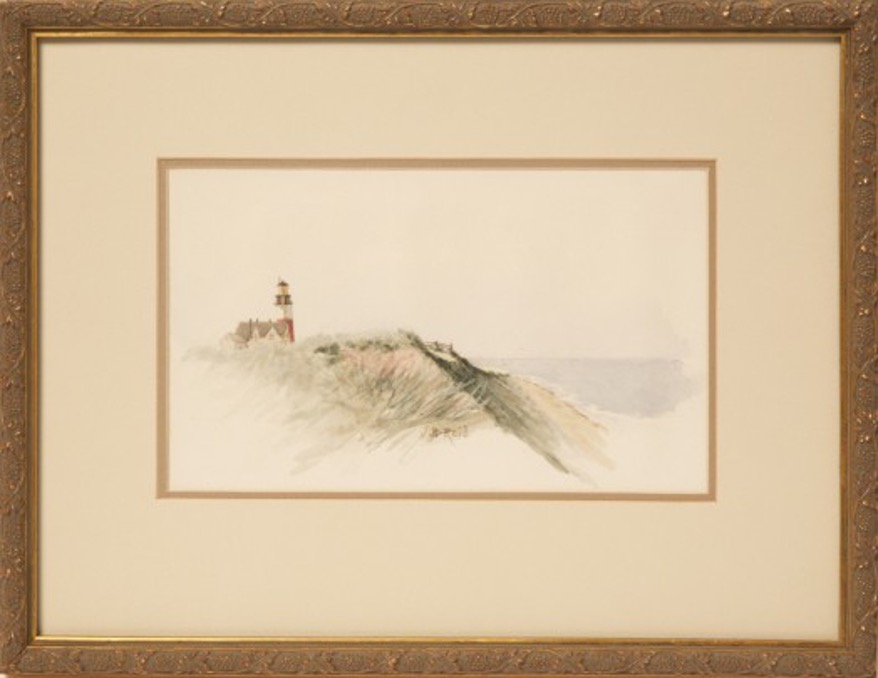
The image that captivated me was a tiny watercolor of Sankaty Point Lighthouse at the eastern end of Nantucket, seemingly floating in midair above the dunes. It was signed in a minuscule hand: “J.B. Reid.” I learned to my dismay that it had just been sold, and went away that day empty-handed. But I was thrilled to have discovered Reid’s work, and anxious to learn more about her. Art – or so I told myself at the time – isn’t about conquest or connoisseurship, but about passion and the magic of such encounters. I had found love, and though the initial prize had eluded me, I would have to find a way to make the relationship work.
Back on Martha’s Vineyard, I did some research on the Internet, and soon discovered another Reid watercolor listed for sale by a different Nantucket dealer. The subject of this one was a barn surrounded by a dory and some barrels: a seemingly lifeless scene, but a beauty. It was identified as a “Nantucket scene, possibly Sconset.” This time I pounced, and I became a Reid collector.
Who was this woman whose brush I’d fallen for? Little is known about Jane Brewster Reid beyond some bare facts, gleaned mainly from dealers’ catalogues. She was born in Rochester, NY in 1862, apparently a Mayflower Brewster, and painted all her life. She may have begun visiting Nantucket as early as the 1890s; in 1902, some of her work was reproduced in a booklet by Henry S. Wyer titled “Sea-Girt Nantucket.”
Reid is also known to have visited and painted in England and Wales. According to Margaret Moore Booker (in the handsome volume “Picturing Nantucket,” edited by Michael Jehle), “Reid may have studied art in England, as her painting style is reminiscent of traditional English watercolorists of the eighteenth and nineteenth centuries.” At least one of her pieces was purchased by the Art Institute of Chicago. Nothing is known of her family, and I was unable to locate any photograph of her. It seems she never married, and she died in Rochester in 1966, age 104.
Reid was already in her sixties by the time the Nantucket Art Colony emerged in the 1920s, an informal group of mostly watercolorists that included a number of distinguished minor artists; its heyday was approximately 1920-1945. But she is listed among the thirty-odd members of the group in a digital retrospective exhibition mounted by the Nantucket Historical Society in 2007 (https://nha.org/ digitalexhibits/artistcolony/).
Most of the artists in the Colony were somewhat younger than Reid, having been born in the 1870s and 1880s. The group’s organizer, according to the Historical Society, was Florence Lang; the “dean” of the era’s Nantucket artists was Frank Swift Chase, who taught plein-air watercolor painting to Lang and others. Many members had studied at the Art Students League in New York, one of the first art schools to admit women. Most were summer visitors, although some settled on Nantucket; they included illustrators, art teachers, designers, and a few Brahmin New Englanders with names such as Folger, Saltonstall, Coffin, and Brewster – as in Jane Brewster Reid.
Further research turned up several dozen of her watercolors – most of them quiet, unpopulated Nantucket landscapes. Some are well-rendered but unremarkable pictures of rose-covered cottages and country lanes; one could imagine them adorning the quiet hallways of the island’s inns. Others, like the study of Sankaty Light and the barn-and-dory scene I had purchased, are more arresting. A few of Reid’s works depict girls at play on a beach, and display her talent; but she clearly preferred painting the island’s nature and architecture to portraying the human form.
Nearly two years after my discovery of Reid’s work, serendipity struck. The same dealer who had sold the Sankaty Point Light watercolor at the Antique Fair, minutes before my arrival, was now offering it again on the Internet. Had the previous buyer had a change of heart? I pounced, and the Reid watercolor I’d originally fallen in love with was finally mine – or so I believed. A likelier explanation, based on subsequent research, is that the artist sometimes did more than one painting of the same scene. No matter; the “Sankaty Light” watercolor – whether the one I’d originally seen or another – lit up my West Tisbury home.
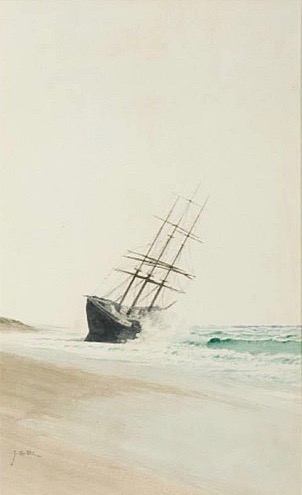
As I continued to explore Reid’s work, one painting intrigued me more than any other. The online image was from a long-ago auction, and it depicted, with delicate clarity, a shipwreck on a Nantucket beach. The auction house had labeled it “Beached Three-Masted Ship.” The idea was hardly original; artists have long painted shipwrecks, and people have bought them – out of fascination and, perhaps, in homage to the nobility of human failure. But to my eye, Reid’s shipwreck scene was special.
Among other things, it brought back a vivid scene from my own childhood. In the early 1960s, as a boy of seven or eight, I’d been intrigued by the sight of a commercial fishing boat that had beached in a storm near Zack’s Cliffs in Gay Head (now Aquinnah) on Martha’s Vineyard. The empty boat lay on its side in the surf, a relic of a recent struggle with the sea. Perhaps it was my first recognition that adults don’t get everything right.
Decades later, I was awed by the maritime works of Winslow Homer, Edward Hopper, and others that challenge the viewer’s sensibilities and sense of stability. (Homer and John Singer Sargent were two of the great American artists who inspired generations of painters, including most of the Nantucket Colony, to work in watercolor.) At the Old Tate Gallery in London, I encountered the watercolors of J.F.W. Turner, including scenes of storm-tossed ships in the English Channel that can almost induce seasickness. Disasters at sea are strange mirrors of our world gone awry. When vividly depicted, they can evoke pity, awe, and a sense of relief that we are merely spectators.
Reid’s shipwreck scene had a startling intensity, with a clarity in the brushwork that seemed to defy the prototypically blurry and impressionistic medium. Like the picture of Sankaty Point Light, it was strikingly minimal for a watercolor: the palette is limited, the composition mostly undefined sand and sky, with the beached ship at the center (her intact rigging exquisitely detailed) and brief renderings of dune and surf on either side. It called to mind the hypnotic poem by Robert Lowell, “The Quaker Graveyard at Nantucket,” an homage to one of the poet’s relatives who was among the thousands of New Englanders lost at sea.
I kept the image of the wreck on my computer desktop, happy to be a digital collector but resigned to the fact that I would never see the original. I clicked on it often to refresh my memory of the haunting scene. The ship, as I learned, was the Canadian barque W.F. Marshall, a new cargo vessel of 945 tons, which foundered on Nantucket in March 1877, en route from Hampton Roads, Virginia to her home port of St. Johns, New Brunswick. She was listed as sailing “in ballast,” i.e., without cargo. The wreck occurred in a thick fog as the ship encountered breakers on the south side of Nantucket and was driven up onto the beach near Mioxes Pond. The spot where it happened is less than a mile from Bartlett Farm, where I first discovered Jane Brewster Reid at the Antique Fair.
Fortunately, all sixteen people on board the W.F. Marshall survived: the fourteen crewmen, and the wife and child of the steward, were rescued by personnel from the Surfside Life-saving Station. So was a black Labrador known as “Marshall the Sea Dog,” who later achieved some renown. (There’s a book titled “Marshall the Sea Dog: A History of Lifesaving and Notable Nantucket Sea Wrecks,” by Whitney Stewart, and an 8-minute video about Marshall the Sea Dog on the website of the Egan Maritime Institute (www.nantucketshipwreck.org/shipwreck/lifesaving-museum/ films.) Later attempts to salvage the W.F. Marshall were unsuccessful.
Reid, who would have been a teenager at the time of the wreck, must have painted the scene years later from a black-and-white photograph; yet her colors are subtle and radiant. Exactly when it was done, and how many other such scenes Reid painted in her long lifetime, are anyone’s guess. But the wreck of the “W.F. Marshall” is surely her most dramatic work.
In the summer of 2017, six years after discovering that elusive first watercolor, I returned to Nantucket. This time I flew over from the Vineyard, hoping to squeeze in a few extra hours at the Antique Fair before catching the ferry back in the afternoon. We circled for some time in a thick fog before finally landing, and I rushed over to the Nantucket Boys and Girls Club where the Fair was now being held.
As it turned out, I didn’t need the extra time. Within five minutes of entering the Fair, I was dumbstruck: there was the “Wreck of the W.F. Marshall,” hanging on a dealer’s wall. Without hesitation, I managed to squeak out the three loving words: “I’ll take it.” And after a quick tour of the rest of the show, I headed off to the ferry with another little beauty under my arm, spiriting it away to a new home on the Vineyard.
How to justify the crime? Well, I’m not a young man. And someday my three Reids (or Nereids – to me, they are sea nymphs of a kind) will return to their native island, still young and fresh, to be the envy of new eyes.
A lighthouse, a barn, a shipwreck: it’s hardly a vast collection. Yet in these and other works, the enigmatic Jane Brewster Reid rendered on paper what so many feel: a deep attachment to the New England coast, and to its architecture, artifacts, and traditions.
Like many artists, Reid never achieved prominence but occasionally outdid herself, displaying an exceptionally keen eye and delicate hand. Excellence doesn’t always equate with fame or sustained virtuosity. It’s where you find it. My sea nymphs, the products of a long but seemingly lonely and mostly forgotten life, evoke a place, an era – and the ineffable power of art.