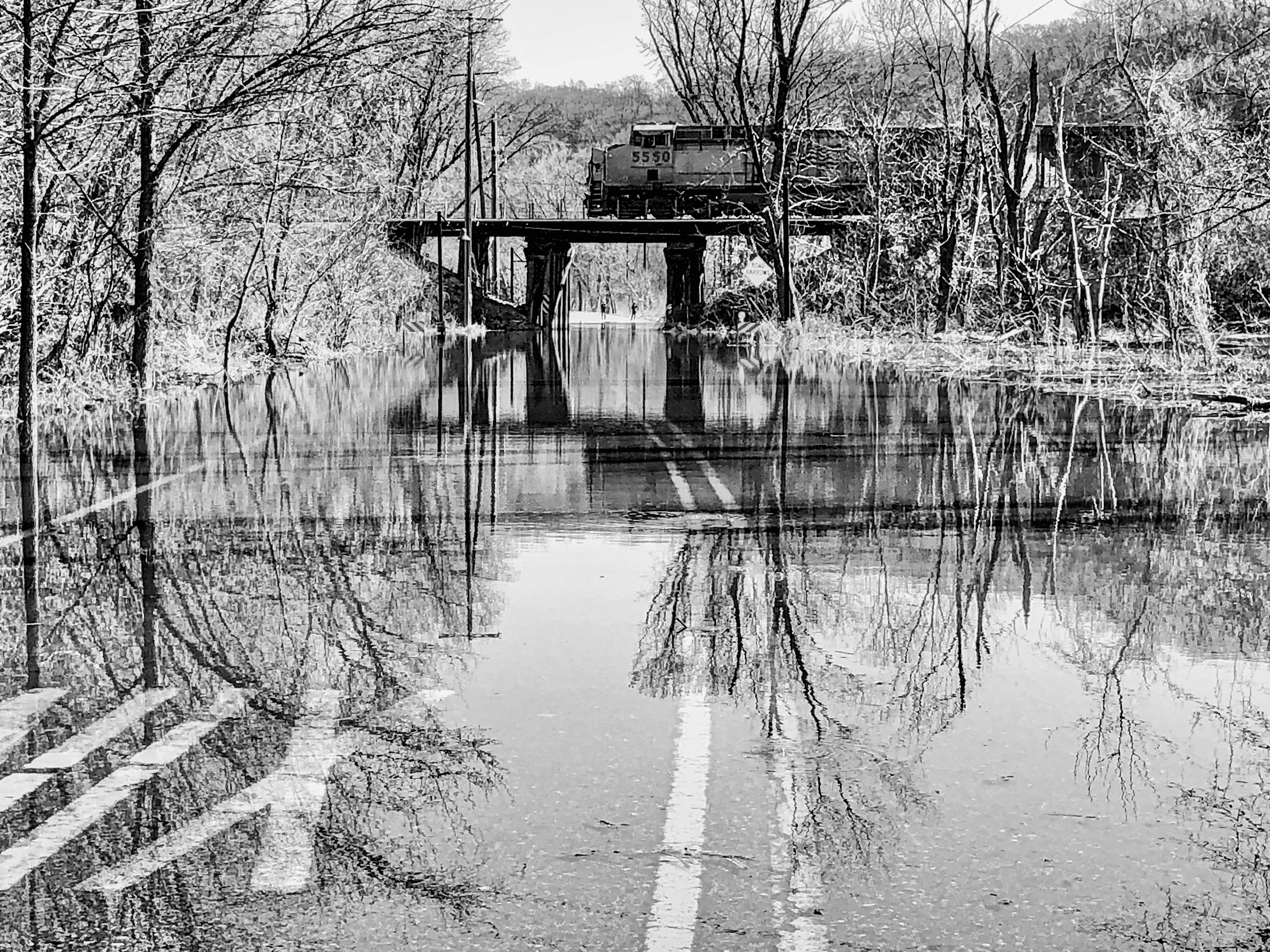
When I was a boy, sometime in the late 1950s, my family moved from our Southern California tract house to a farmhouse on the eastern outskirts of Bangor, Maine. The Penobscot River is a stone’s throw from the house, just across U.S. Route 2—nominally a highway but really just a two-lane country road—and a single-track railway. The road and its fast-moving cars were an attractive nuisance to our dog Daisy, a sweet-natured, excitable Dalmatian mix, who ended up as roadkill. The train tracks and the river were an attractive nuisance to me and my brother Mike and our two friends, sons of a doctor who lived on the grounds of the nearby state hospital, or “loony bin,” as we called it.
The realm between the road and the river was made for exploring. The world literally passed it by: below the sightlines of people passing in their cars with only the road and their destination in view, it was an abandoned space known only to the train engineers, the hobos, and the barefoot boys of summer. We flattened pennies and dimes under the wheels of the freight trains that came through a dozen times a day and talked of making spoon fishing lures out of the bright elongated slips of metal. We investigated the hobo camps littered with Sterno cans and chatted up the hobos, on the few occasions when we found any. It was somehow common knowledge that they drank the Sterno for its alcohol content, and that it was a dangerous thing to do. We fished for eels in deep spots along the riverbank. The eels would gladly take our bait, and once hooked, engaged us in a tug of war. We visualized them winding their prehensile bodies around a snag on the bottom. If our line was strong enough, we could rip them away from their holdfast and land them easily.
I don’t remember eating them, or even thinking of them as edible. Although the river held a fascination for us, we avoided touching the water, which was the color of weak tea and stank of pulp-mill and tannery waste, and probably worse things. There were rumors of medical waste washing up on the riverbank. Mike and I were capable swimmers, but the last thing we ever wanted was to be immersed in that yechy water.
One day the four of us explored farther than usual and probed the defenses of a hydroelectric plant, a complex of buildings on the bank of the river, next to a dam. We slipped through a loosely chained gate in the fence, and found ourselves in a storage yard between buildings: a new world of unfamiliar industrial objects to speculate about. We could hear the whine of the turbines in the outermost structure: a big brick building with a two-story façade, it abutted the dam on its far side.
I wondered why it seemed so deserted—when a door opened and a man came out and yelled at us. His anger prompted us to flee, but he stood in the way of our return, so we took the alternate route around the end of the big brick building, and inched along sideways on a narrow concrete ledge, with the brick wall at our backs, looking down at the water spilling over the dam.
The Veazie Dam, which was demolished in 2013, was really a weir, with the river constantly flowing over the top of its whole width. If you looked at it closely, which we were compelled to do, you could see the piss-colored water at the top of the weir rushing smoothly and forcefully over what looked like planks oriented in the direction of flow and gently sloping downstream. At their lower end was a waterfall about 20 feet high. Our position was alarmingly exposed over the surging and crashing waters of the dam. I don’t know how we kept our nerve.
At the building’s end, the concrete ledge we inched along extended as a wall bordering the deep water of the reservoir, topped by a handrail of steel pipe, with one rail at the top and one halfway down the posts. Just beyond the handrail was the familiar abandoned world of the river bank, with its weeds and spindly volunteer trees. We went over the handrail one by one, and I came last. As I shifted my body around to face the handrail, my hand slipped from the top rail, and I felt myself falling backward toward the river.
I made a desperate grab at the middle rail, caught it, and climbed over to safety.
Probably my companions were as shocked as I was by this barely averted disaster, but nobody spoke of it. I believed it lived on only in my memory, and I often replayed it and imagined how I might have fared, had I fallen into the river. Could I, by strength and luck, manage to avoid being washed over the edge of the falls? And if I could cling there, how could I be rescued? I knew it was beyond the abilities of my friends to do that. They would have to appeal to adults, and the nearest adult was the one who had scared us off. In my imagination, their quandary was almost as uncomfortable as mine, and I resented them bitterly for thinking of their own comfort when my life was at stake. But then, if I couldn’t cling to the top of the weir, and was swept over the edge, could I somehow survive and swim free of the falls’ turbulence? And if so, how much of that chemical and microbial soup would I swallow, and how sick would it make me? Or would I miss all these chances, and end up like the corpse I saw the police pull from the river near our house one day, with his gray skin abraded and peeling? Then would Mike, who usually took the lead in our adventures, be haunted by guilt? The possibilities were as endless as they were somber. And sometimes I thought that I was never in any real danger, that my nerves and reflexes were perfectly adequate to the situation, that the ledge wasn’t really all that narrow, that what in retrospect looked dangerous was really quite easy, and even a reasonable thing to do.
When I had obsessed about it long enough, all the might-have-beens ran together in a blur, and I became inured to the strong feelings evoked by these memories, relieving me from my existential unease.
As I wrote this, I did some research online, to refresh my memory of the place, and I learned about the hydraulic phenomenon known as a “hole.” At the foot of a weir, the plunging water drags down the surface water, causing it to flow backwards against the current, and forming a gyre that traps any floating object. Without white-water training, my instinct to stay on the surface would collide with my instinct to swim downstream, away from the sucking falls and the deadly turbulence. This vision plunges me from emotion recollected in tranquility into a fresh accession of dread, and I'm once more in the hole, the endless gyre of speculation about what might have been, alternately robbed of all my life experiences since boyhood, then safe and dry again in a forgiving world.