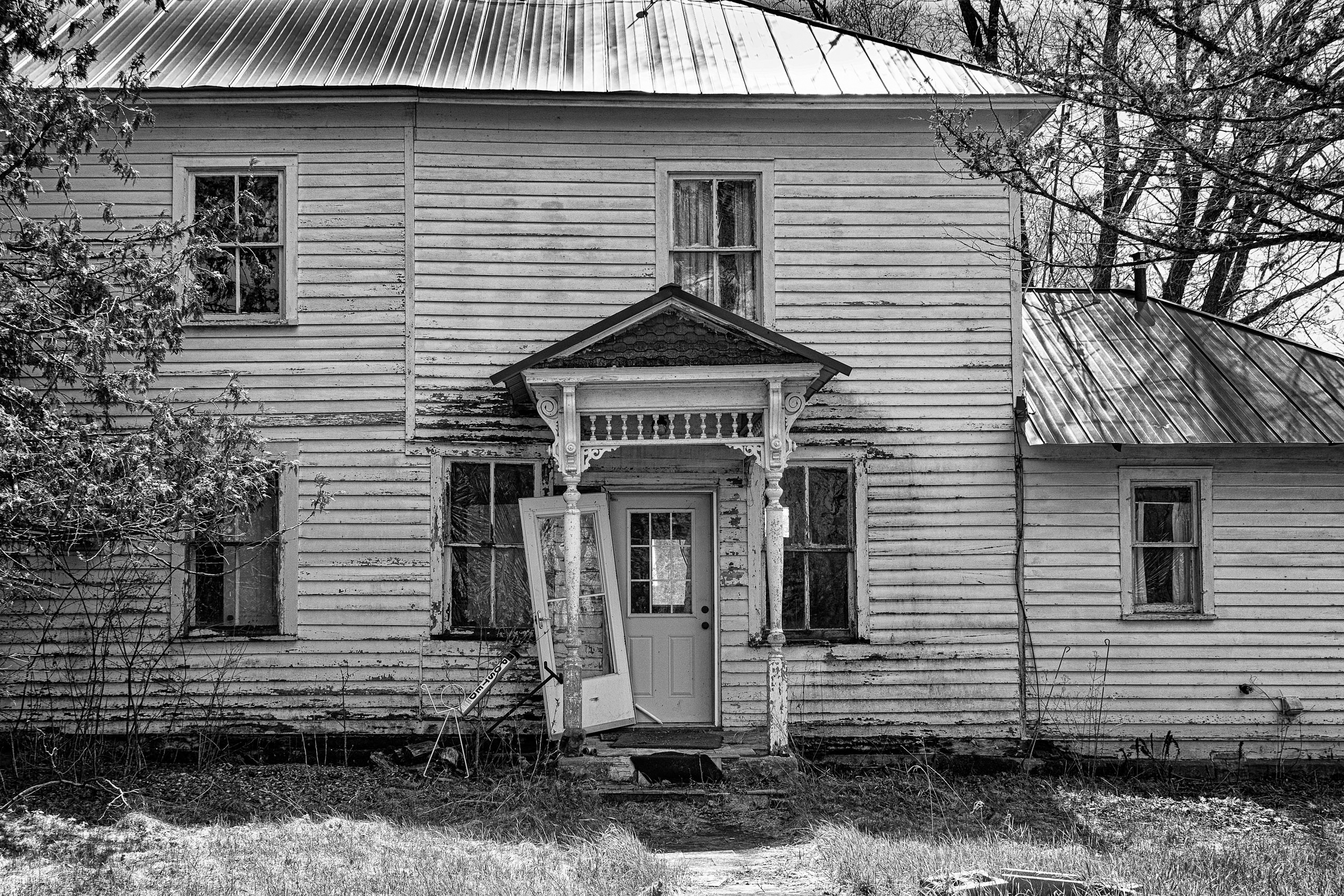
My mother is a translator. She works remotely from a little house tucked into a wooded area. Not far from the house is a hilly field and within that field lies an old rusting car. I don't know what kind of car it is, just that it is old and a deep dirty reddish color, like a fallen chestnut spotted with mud. Thick weeds grow all around, and from certain angles, and on certain days when the sun is bright, it looks like the car is sinking. I sometimes seek out these angles and allow myself to be tricked into believing the car is actually sinking. The feeling lasts a moment and then the scene returns to normal. I walk to the vehicle, find it sits exactly as it did on my last visit, and leave to go back to my mother's house.
My mother translates books from French to English, Spanish to French, German to Spanish, Portuguese to Italian, and so on. Every now and then a small shipment of books arrives by mail and is deposited by a post office worker in the mailbox at the end of the driveway. On days when my visit coincides with a delivery, I walk down the driveway to retrieve the books and other mail. Otherwise, my mother will do this.
On my last visit, I told my mother something a coworker of mine told me, that she, my mother, is a polyglot.
"I'm told you're a polyglot," I said to her. She was sitting at her customary desk in the den area of the house. A desk lamp with a green glass shade lit her work area, and the top of her head and the small peaks of her shoulders seemed to glow. She leaned left, then right, then left again, alternating between typing and jotting notes on a pad. Opposite the lamp two books were propped up and open, sitting in special stands. One of these I know was the book my mother was translating. The other I think was a dictionary. I was in the kitchen unloading the groceries I had brought, one of the main functions of my visits.
"That is an ugly word," my mother answered me after a slight delay. I placed a few jars of preserves and cans of condensed soup on a shelf in the pantry. "Please don't call me that," I heard her then say after a time.
When she is at her desk working, she speaks without any movement in her voice. The words sound like they are coming from another place, a room I can't enter. I know my mother's attention is focused on her work. She hears me, but it’s like she is not in this house in the woods where I stand in the kitchen unloading groceries. Occasionally if I ask her a question, the time it takes for her to answer is so long I have forgotten the question. This happens every so often and I know it is just the effect of my mother's intense concentration on the book she is translating. Still, there have been moments, following a visit to my mother, on my drive back into the city where I live and work, when I imagine things I said to her having to travel great distances to reach her. I think about the starlight—barely visible in the city, but bright and crisp out at my mother's house—and how the flicker we see at night is the billion-year-old burning of a star just now reaching us.
In the city, I work four ten-hour shifts loading and unloading cargo at a shipping port. In the carrier terminal, massive gantry cranes slide back and forth, lifting and lowering cargo containers from vessel to unloading zone, from loading zone to vessel. The containers are big rectangular blocks, red, green, blue, black, white, yellow. I stand on the dock waving to truck drivers and crane operators. I use handheld signal flares to point out where drivers must stop, when the crane operator should lower the spreader, and when the drivers are clear to exit the loading or unloading zone. When a truck pulls up, the spreader drops slowly until it is properly aligned over the container. It fastens onto the fittings and hoists the container from the truck's chassis. The box rises high in the air, swinging ever so gently from the network of steel cables linked to the boom machinery above. It seems to float to the cargo vessel where it is lowered into the hold or stacked on the deck like a brick. The truck drives off and a new truck approaches. The cycle begins again.
All up and down the quay cranes are at work hauling containers one by one. Their motions remind me of arcade games with a movable claw. The containers they lift can weigh many tons depending on the load, and I have thought about what might happen if one were to fall. How many of us would die? Me and the other signalers are more at risk than the crane operators or the lashers up on the ship. But there are plenty of other longshoremen like myself who are also at great risk. I have asked some of my coworkers about this risk of death, what might happen if a container were dropped or a stack of containers toppled over, and they all say the same thing, more or less. "Stop daydreaming, Glen, get your head out of the clouds." They say the only way something like that might happen is if someone loses focus. "Stay alert, stay alive!" they all say. And then as we're walking back to our posts, adjusting our hard hats and green reflector vests, one of them usually yells something about my mother. "By the way, how's that polyglot mom of yours? Why don't you tell her I got some Italian tongue twisters I need her to translate!" They're only joking when they say things like this, but it still hurts to hear it, knowing my mother is hard at work and innocent. It's my fault for mentioning her to my coworkers. They are friendly people but they never miss a chance to mock or toss out a lighthearted insult.
Out on the quay it is windy and full of noise. Salty moisture clings to everything and little piles of sand have gathered along the lower edges of the iron mooring posts. The gantry cranes clank and hiss as the containers are being deposited into place with a thud. People shout, trucks beep as they reverse into a terminal or fueling station, and the harbor waters spit and slosh against the hulls of docked ships. In the open spaces between berths I can see the silhouette of the city far away across the harbor. The buildings don't look solid, and the blinking lights at the tops of skyscrapers seem sunken in a gray film.
My mother sits at her desk, translating in silence, alone in her house in the woods. She reads each word very closely, maybe a dozen times before she translates it. She becomes each word. Her thoughts zero in on words one by one, and inside each she sees a reflection of herself. And she reproduces that reflection in a different language. When there are no words left, she moves on to the next book, the next language, the next collection of words. Time moves in a parallel place, an "elsewhere" cut off from the act of translating, and my mother knows nothing about the movement of the clouds outside her house, the swaying of the pine trees, the trickling of rainwater in the downspouts. She is inside her house inside her head inside the book she is translating and inside word after word.
My mother is not eating. The groceries I brought her last week sit untouched in the refrigerator and pantry. The seal on the milk carton is intact. Cold cuts weigh the same as when I bought them. The loaf of whole grain bread, the same size. Lettuce is wilting. Tomatoes are soft and shriveling. Everything is as I left it like my mother has not been here for days.
"You haven't eaten," I say to her, and begin making her a ham and cheese sandwich with Black Forest ham and American cheese. I toast the bread, spread on some mayonnaise, add a few leaves of lettuce and a couple pickle chips, the same way I pack for my own lunch on days I work. Except instead of mayonnaise, I like mustard, and instead of American, I like Swiss cheese. When I was younger, my mother sometimes shared secrets about words. She told me their origins. I have forgotten most of these, but one that has stuck is mayonnaise, from the French, mahonnais, of or from Port Mahon. Another, not surprisingly, is translate, from the Latin, translatus, carried across.
I walk the sandwich in to my mother. The den feels chilly and everything seems a shade darker than usual, even the desk lamp. As usual books are open and upright in their stands. My mother's frail fingers move slowly over the typewriter keyboard. She bends forward studying the pages before her, whispering things to herself. I put the plate with the sandwich on the wooden seat of a nearby stool.
"How about a lunch break?" I say.
She pauses and turns her head toward me. She looks both confused and hyper-aware. This is a side effect of being submerged in the work of translating. She is returning to time. But there is also a tiredness to her features I have never seen before, a fatigue that has gathered in the shadows of her eye sockets, the pale line of scalp where her gray hair is parted, the dark creases of her wrinkles.
My mother glances at the sandwich on the stool and says something in a language I can't understand. Then she says: "What time is it?"
I look at my watch and tell her it's one-seventeen.
"Go and check the mailbox, please, Glen," she says before turning again to face her books and typewriter. She flips the page of one of the books and slides it under a clip fixed at the book's top left corner. She leans over and writes something on the notepad, and as she does this I notice another sheet of paper poking out from under the notepad. In all my years of watching my mother translate, I have never seen such a piece of paper, almost hidden in its placement beneath the pad.
Instead of going straight to the mailbox, I first walk to the old car rusting in the field. It is a warm dry day, but the thick overcast prevents the sun from reaching the ground. I move from one position to another along the field's outer edges, waiting for a blade of sunlight to cut through the clouds and shine on the dark car. But it doesn't happen and the car just sits there unchanged, resembling a dark brown shell. I imagine the car creeping off very slowly and disappearing into the gray shadows of the tree line, as though a slug had taken refuge inside it.
I follow the trail through the woods back to my mother's house. I light breeze makes the leaves all around me rustle, and even though it is summer and everything is green the foliage sounds brittle and dry.
There is a package in the mailbox along with a couple letters. On one of the letters, I recognize the name of a publishing company my mother translates for, Tarantella Books. “Tarantella,” I hear my mother say to me inside a memory from long ago, “Italian, from the name of the seaport Taranto.” She is much younger, and I am just a boy. We live in the city. Daylight fills the large room where my mother translates. She is sitting with her back to the desk, facing the center of the room where I stand barefoot. She sings the word tarantella, repeating it over and over, rolling her tongue the way an Italian would. I start spinning around. The room is lined almost entirely with books, hundreds of them on long shelves, in stacks on the floor, scattered near the baseboards, all hugging the white walls. As I spin, the books begin to blur and with each rotation, my mother's form loses definition until she and the books and the bright daylight from the windows all blend into one watery texture. The only thing that remains clear is her voice singing, "Tarantella! Tarantella!" with an Italian accent, a rhythm and melody I spin and bob to. Then I collapse on the floor, breathless and dizzy. The room tilts like a listing ship and for a second it seems like everything, books, desk, me, my mother will be dumped out the window's small opening into the outside air.
"That was fast," my mother says as I walk in the door. I was gone for almost an hour, but when she is translating an hour must seem a second. The sandwich is gone from the plate. I replace the empty plate with the package and letters.
"How was the sandwich?" I say.
"Just how I like it," my mother says, reaching for the package. I am surprised at how quickly she answers me.
"When will your next visit be?" she asks.
"Saturday."
"What's today?"
"Wednesday."
Before leaving I remind my mother to eat, and I promise her that I'll bring the groceries on Saturday, as usual. I wait for her to ask me about my job or maybe just make small talk, but she stays silent and returns to her work. For both of us, there is nothing new to share, I know. We pass our days in the same manner, she translating, me loading and unloading the cargo ships. Our work is unrelated, and now that we are older there is little left that might bridge the gap of years and livelihoods.
"I'm thinking of restoring that antique car out in the field," I say to my mother from the kitchen. I hear a murmur and the shuffling of pages. My mother responds sharply.
"That old heap of junk? It can't be salvaged."
I leave her house wondering if she thinks I grind out my hours hopelessly on the quay.
Two days later I am sitting in the port cafeteria. It is lunchtime. Rubber boots squeak all around me. Raincoats and sou'westers hang on racks along the walls, dripping dirty rainwater to the floor. My coworkers' gruff voices fill my ears while farther off, toward one end of the large room, the rattling of cookware echoes from the kitchen. Everyone is excited and agitated. They interrupt each other, shout over each other, dismiss each other with bursts of laughter that quickly dissolve into silence. They are talking about a cargo ship, the SS Chol. It was scheduled to dock here yesterday in Berth Three but never arrived. News came earlier today that the ship has sunk, and is now missing. I learn from my coworkers that crews from the Coast Guard, Navy, and Air Force are all out searching for survivors.
"They won't find anything but flotsam out there," someone says.
"I heard they got a body, but they don't know who it is," someone else says from the end of the table.
"No, they only found a lifeboat, half-sunk. Empty. The thing's hull was cracked through."
"It was the ship's hull that cracked, not the lifeboat. That's why it went down so fast."
It grows quiet. Some of us take bites of food and sips of water or coffee. The cafeteria's long horizontal windows are streaked with shivering trails of rainwater. It has been raining almost continuously for the last thirty-six hours. Outside the windows are stacks and stacks of cargo containers. They look like melting slabs of color from the rain on the glass. I wrap my sandwich up and put it in my lunch pail.
The conversation turns to the Chol's captain. A few people agree it was his fault, that he didn't take proper safety measures, that he underestimated the strength of the sea, and he ignored warnings of the deck officers. But the man sitting next to me claims the ship's owner is to blame. "They didn't employ a safety officer," he says, "and the lifeboats were open air, not fully enclosed."
"What's it matter when your captain's a jackass!" someone yells. Everyone chuckles in agreement. Lunch ends and we head back out into the rain and wind.
On the way to my post, I pass Berth Three. It is just a wide empty space opening onto the rough harbor waters. The gantry crane is parked, its motors and cranks silent. If it weren't for the bad weather, I would have a spacious view of the city, a view much more encompassing than normal. But the city is invisible. The air is filled with a thick stormy grayness. Clouds, rain, and fog blend into one mass that now looks like a solid unbreakable wall, now like a strange build-up of smoke without any endpoint.
I continue walking to my post at Berth Five and begin signaling crane operators and truck drivers with my flares. The flares are bright orange and use halogen bulbs visible even when conditions are poor like today. We are unloading containers from a ship that has come over from Europe. I know this because of the identification markings on the doors of each container. I direct an approaching truck in and motion to the crane operator high above. He lowers a fresh container. The brim of my sou'wester extends far over my eyebrows and I'm forced to tilt my head back further than usual to get a good look at the incoming container and the operator's cabin. Rain smacks loudly against my coat and when the container is hauled down into place I hear the heavy droplets plinking as they collide with its metal frame. I wave to the operator, the spreader unhitches, and on my cue the truck motors away, splashing through enormous puddles. Work goes on like this for hours.
Then something happens. An alarm sounds from somewhere high above, likely the bridge castle. In seconds a group of men sprint across the quay from the port security offices. They scramble up the gangway and disappear through a tiny hatch into the ship. We continue working. Finally, the alarm stops. In the midst of the pouring rain and the truck's idling engine, I think I hear screams or yelling. Moments later the men exit down the gangplank. I make out a port security officer, a pair of uniformed Customs agents, and a handful of crewmen. The Customs agents usher a young woman whose hands are cuffed behind the back. Her steps are slow, exhausted. Her hair is already drenched. Her ragged clothing hangs heavy and sodden from her slight, bony frame. I watch them return to the security offices.
Anger and sadness mix inside me as I wonder about the woman. I imagine her hiding herself in the depths of the ship, possibly in a container within a cargo hold. I imagine her hunkering in darkness for days and days, without food, without water, nothing but her own breath and a vague sense of self that comes and goes with the endless rocking of the ship and the faint noises from the engine room. In place of the world, in place of time, there is a hope building in that blackness she inhabits deep within the hull. There is no return, no past, no before, only a hope that feeds on darkness and hides inside a famished body.
"Hey! Quit your castle-building and wake up, stevedore!" The truck driver is hollering through the rain. His horn rings out. I drop one of my signal flares and he laughs as I quickly pick it up. A container is eased down onto the chassis. Grinning, the driver inches forward and stops the cab close to where I stand.
"It's just some bum stowaway," he says out the window. "They say she's half-starved. Barely legal."
"How do you know?" I ask.
"Guard told me. I passed him on my way here. Said she would've died if they didn't find her first. Probably can't speak the language."
"Maybe."
"Hey, Glen!" he shouts as he shifts into gear. "Why don't you call your mom down here to translate for her?" The window rolls up. His hoarse laugh fades into the pattering rain.
The next day I drive out to my mother's with the groceries. In the city it is still ash-gray and gloomy, though the rain has finally let up. But the closer I get to my mother's the brighter and bluer the sky becomes until at last, as I pull up the driveway, the sunlight glares down above the trees and shimmers on the hood and dashboard. I am excited to see my mother, and I look forward to visiting the field to see the rusting car.
It is dark in the kitchen as I enter through the back door carrying the plastic grocery bags. My mother is not at her desk and the lamp is unlit. Its green glass shade appears black in the shadows of the room, while the bookstands sit empty. Side-by-side, their strange wire structures resemble the half-visible skeleton of an unknown animal. I call my mother’s name, but there is no answer, only a silence different from the silence of my mother translating. I begin unpacking the groceries, letting the swish and rustle of the plastic bags fill the space for a time.
It occurs to me that so much of these groceries I bring to my mother arrive here on cargo ships. I unload the cargo containers, the containers are brought to a warehouse and unloaded. Then the cargo is reloaded into a truck and driven to a grocery store where they are unloaded again and shelved in the store. I buy them, load them into my car, and finally unpack them in my mother’s kitchen. This is a cycle that has no end.
After putting away the groceries, I call to my mother again, but still, there is no answer. The silence rolls out over the den and kitchen from the rooms’ shadow-darkened corners. It is a heavy silence that sinks all it touches. I leave to see the car, thinking I may run into my mother along the path or even in the field itself. In all likelihood she is back at the house in her upstairs bedroom, asleep.
Even with the intense sunlight splashed over it, the car looks different, older, rustier, more worn down. I pace around, up and down the hillocks, keeping my distance, searching for that perfect angle that will combine with the brightness and give the car that aspect of submergence. But no matter where I stand, the car looks the same. I squint, blink rapidly. Then I open my eyes wide until they burn and tear. The car's bold brown form seems to liquefy and flow toward me. I brush the wetness from my eyes. This is not the change in appearance I am waiting for.